• 0Shopping Cart
Antarctic Heritage Trust
  • CONSERVE
    • Ross Sea Heritage Restoration Project
      • History of the Project
      • Season Update
    • Explorer Bases
      • Borchgrevink’s Hut, Cape Adare
      • Scott’s Hut, Hut Point
      • Shackleton’s Hut, Cape Royds
      • Scott’s Hut, Cape Evans
      • Hillary’s Hut, Scott Base
      • Location Map
    • Famous Discoveries
      • Ross Sea Party Tent
      • Shackleton’s Whisky
      • Century-old Fruitcake
      • Dr Edward Wilson Watercolour
      • Levick’s Notebook
      • Ross Sea Party Photos
      • Shackleton’s Beer Barrel
    • Antarctic Peninsula Partnership – UKAHT
      • Port Lockroy
      • Stonington Island
      • Horseshoe Island
  • SHARE
    • Latest News
      • Blogs
      • Conservation
      • Inspiring Explorers™
    • Immersive Technology
      • Scott’s Discovery Hut Minecraft World
      • Scott’s Discovery Hut Virtual Reality Experience
      • Hillary’s Hut Virtual Reality
      • Bookings
      • Antarctica 360 VR
    • Outreach & Publications
      • Across the Atlantic
      • Polheim
      • Strategic Plan
      • Annual Impact Reports and Financials
      • The Explorer Newsletter
      • In Nansen’s Footsteps Film
      • Mt Scott Film
      • The Last 36 Film
      • On Satin Waters – Musical Composition
      • Frozen in Time: Scott’s Antarctic Legacy Podcast
      • A Musical Journey to Antarctica
      • Climate Insights from Antarctica: Exclusive Interview with George Denton
    • Exhibitions
      • Still Life
      • Breaking the Ice: The First Year in Antarctica
      • The Frozen Wild: Photographic & Soundscape Exhibition
    • Educational Resources
      • Icy Heritage – Antarctic Heritage Trust Digital Collection
      • Scott Polar Research Institute
      • Royal Geographical Society
      • LEARNZ Virtual Field Trips
      • Cool Antarctica
      • Antarctica New Zealand Image Library
  • ENCOURAGE
    • Inspiring Explorers Expeditions™
      • 2026 – Antarctic Peninsula
      • 2025 – Ross Sea Antarctica
      • 2023 – South Georgia
      • 2022 – South Pole
      • 2022 – In the Footsteps of Hillary
      • 2021 – Mahu Whenua Traverse
      • 2020 – Antarctic Peninsula
      • 2019 – Antarctic Peninsula
      • 2018 – Greenland Ice Cap
      • 2017 – Climbing Mount Scott
      • 2015 – Crossing South Georgia
    • Young Inspiring Explorers™
      • 2024 – April Summit
      • 2023 – November Summit
      • 2023 – Explorer Conference
      • 2022 – November Summit
      • 2022 – June Summit
      • 2021 – Worsley Weekend
      • 2021 – Explorer Conference
      • 2020 – Summit
      • 2020 – Worsley Weekend
      • 2019 – Summit
    • Inspiring Explorers Education™
      • Scott’s Discovery Hut Minecraft World
      • Antarctic Augmented Reality
      • Antarctic Virtual Reality
      • Meet our Education Team
    • Updates and Applications
      • Apply
      • Latest Inspiring Explorers™ Updates
      • Reach the World Partnership
  • SUSTAIN
    • Ways to Give
      • Donate Today
      • Become a Member
      • Renew Your Membership
      • Donate an Artefact
      • Leave a Gift in Your Will
    • Supporters and Partners
      • Our Partners
      • Sponsorship Opportunities
      • Your Impact
    • Inspiring Explorers™ Fund
      • About the Inspiring Explorers™ Fund
      • Donate to Inspire Explorers
      • Explorer Journeys
    • Shop
      • Gift Ideas
    • About AHT
      • Work with Us
      • Sustainability Framework
      • Alumni
      • Our People
      • Contact Us
    • Facebook
    • Twitter
    • Youtube
    • Vimeo
    • Instagram
    • LinkedIn
    • Mail
    • Mail
    • Mail
    • Mail
  • Search
  • Menu Menu
  • About AHT
  • Our People
  • Work with Us
  • Latest News
  • Donate
  • Join
  • Image Archive
  • Shop
  • Contact Us

Archive for category: Antarctic Blog

High Tea on the Icy Sea

July 12, 2016 - Antarctic Blog

By Ciarán Lavelle

They came from the North and they came prepared, well they came with everything they thought they needed, only stopping short of a kitchen sink. The men of the early exploration of the Antarctic continent were no doubt confident that they were going to have a cold time of it. And a good cup of tea and coffee was an essential to beat back the chill of the icy landscape. When it comes to tea the British know how to plan with a large collection of tea and coffee remaining in their original ration tins. The Cape Adare hut contains many fine examples of the hardwearing workman like iron-enamelled cups for everyday use from which the explorers imbibed this important heat infused nectar. These sturdy cups have suffered corrosion and enamel loss but still look much like they would have when their owners would have been huddled round drinking the steaming contents to the chorus penguin hoards nestled in the landscape around the small hut. The results of the removal of the iron corrosion and stabilisation of the cup before preparing for the cups return to the Antarctic climate can be seen in the pictures below.
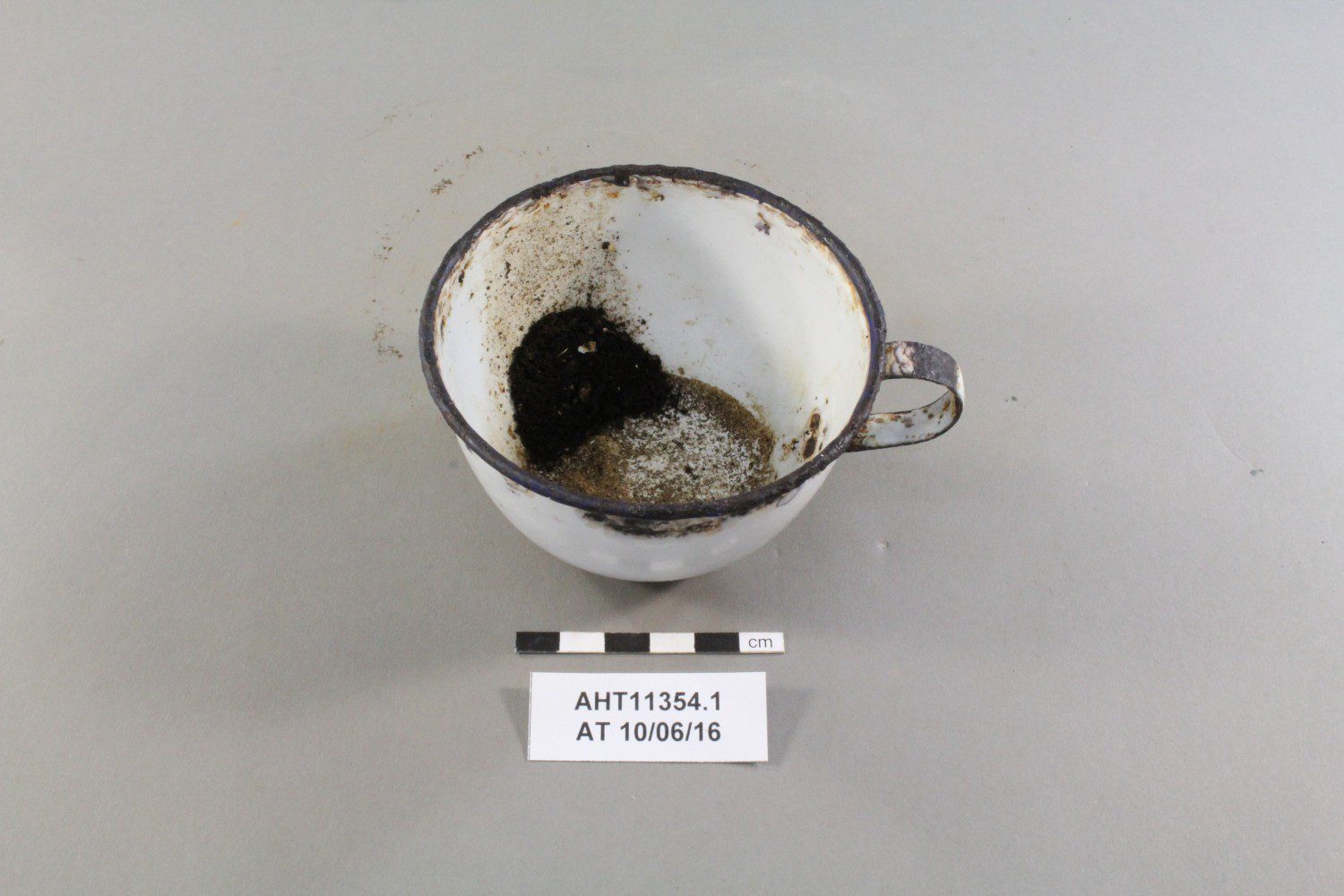
The enamelled mug after conservation with the remains of the last cup of tea still visible in the mug.Antarctic Heritage Trust

The enamelled mug after conservation with the remains of the last cup of tea still visible in the mug.

Although drinking tea and coffee was no doubt a common place necessity this did not mean they couldn’t drink it in style. In the hut there can be found beautiful examples of fine bone china tea cups. Unfortunately the more fragile fine bone china mugs have not survived the trials and tribulations of the Antarctic environment as well as their metal cousins. This fine bone china mug came across our desk in multiple fragments leaving me with an inviting 3D jigsaw to reconstruct.
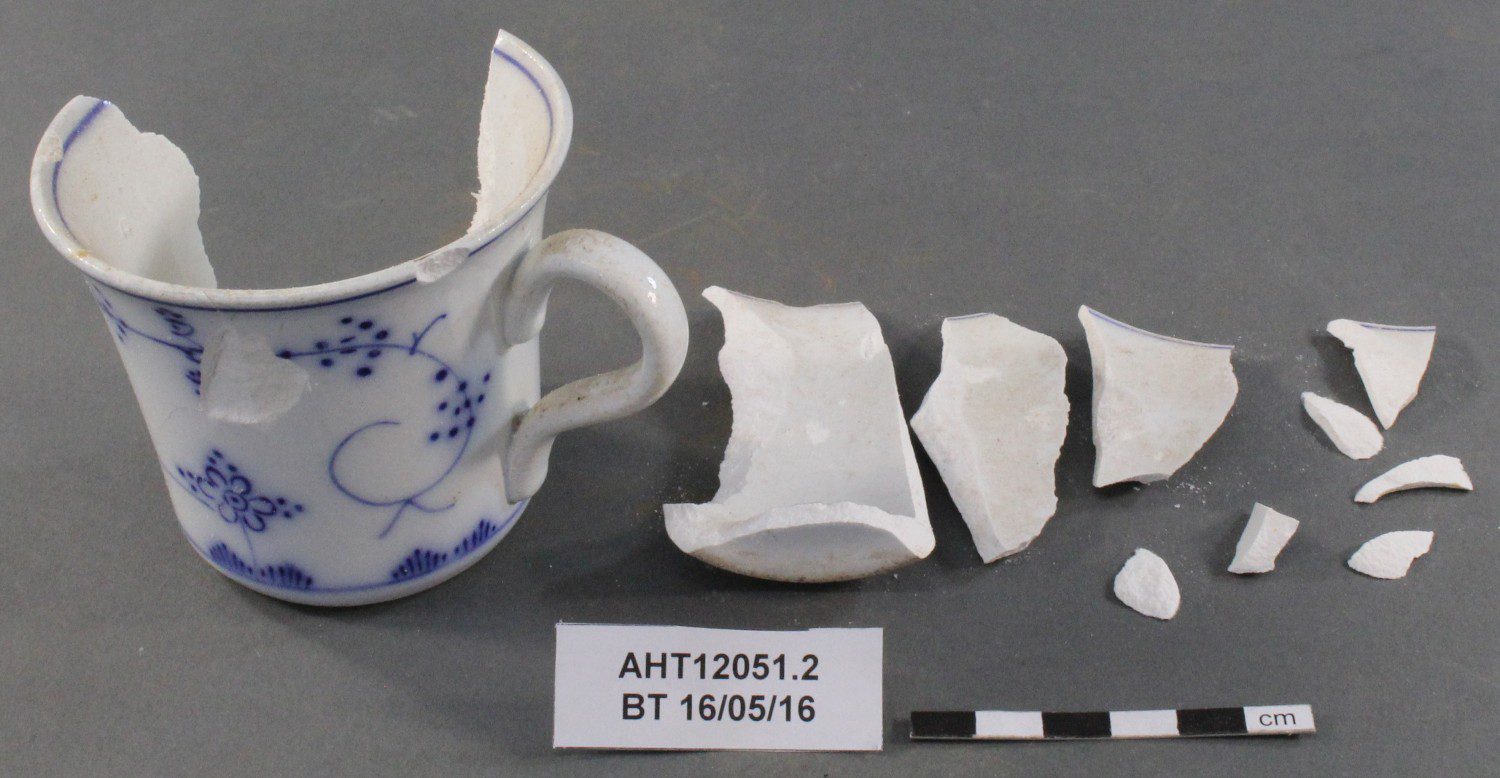
The bone china tea cup before conservation – an inviting 3D jigsaw and a challenge acceptedAntarctic Heritage Trust

The bone china tea cup before conservation – an inviting 3D jigsaw and a challenge accepted

The task of the conservation process is to reconstruct it so it can be reversed in the future if it is needed so great care is taken and deliberation is needed to decide on the best adhesive to use.
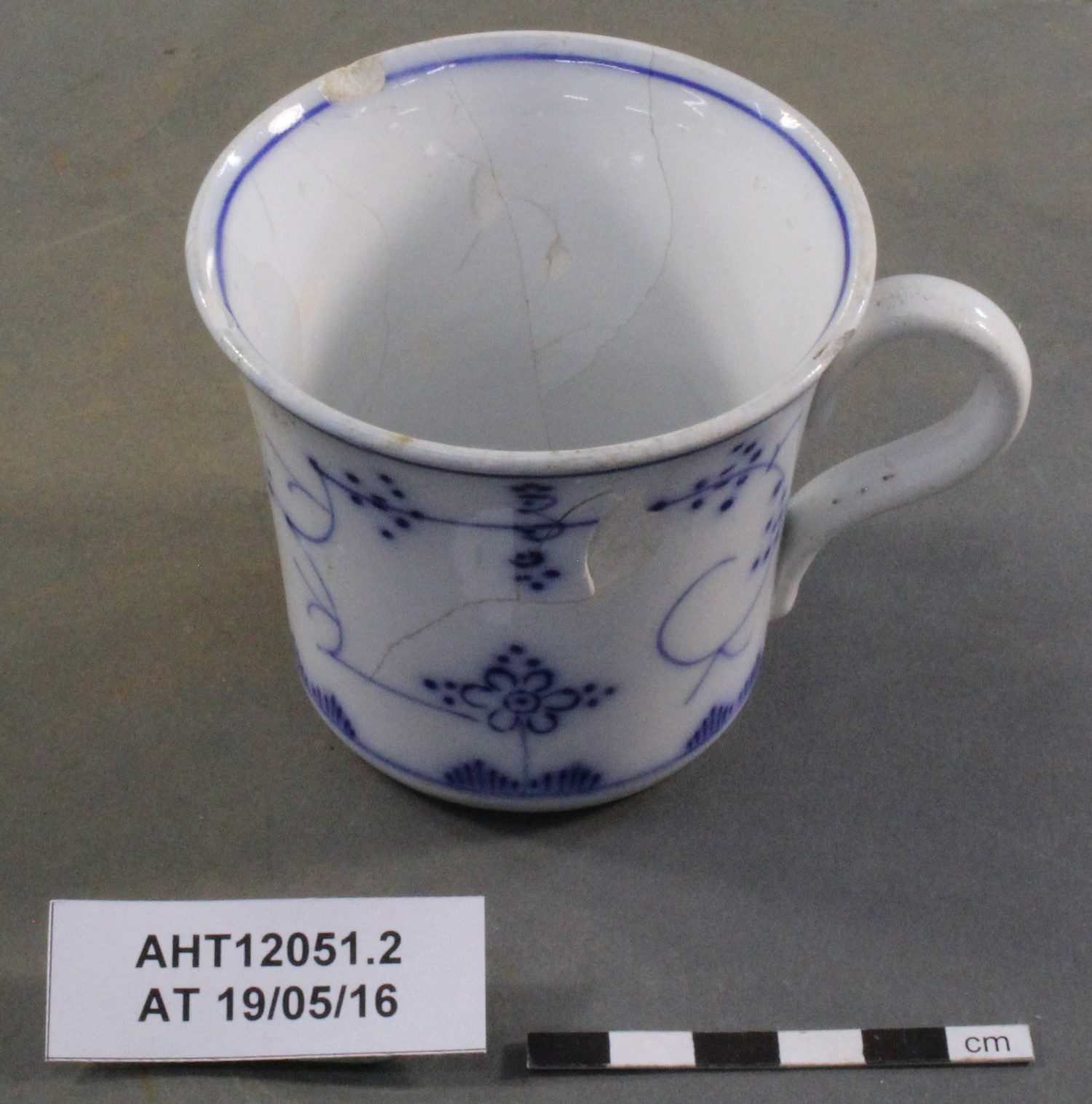
The bone china teacup after conservationAntarctic Heritage Trust

The bone china teacup after conservation

In the end we were able to bring back to life evidence of essential fine dining accompaniment. And as I look at the cup I can imagine a gruff beaded man in well-worn extreme weather clothing sitting in that small cramped candle lit hut sipping from the cup like a fine European gentle man, pinkie raised, enjoying a bit of high tea on his icy sea.
https://nzaht.org/wp-content/uploads/2019/01/the-bone-china-tea-c57f19625553f57.49659320-1500x.jpg 1516 1500 Comms https://nzaht.org/wp-content/uploads/2019/03/logo-dark.png Comms2016-07-12 00:17:572019-04-30 10:59:31High Tea on the Icy Sea

Reinvigorating a City … and History

July 4, 2016 - Antarctic Blog

By Sue Bassett

Conserving artefacts from the early British Antarctic expedition huts whilst actually living in Antarctica is without doubt a unique, ultimately challenging and wonderful experience for any conservator. Truth be known, it’s life-changing.

The Trust’s current artefacts conservation team, working on the contents of the earliest and most remote British hut in Antarctica, is based in Christchurch. This is because it was logistically simpler to transport frozen artefacts from Antarctica’s Cape Adare to New Zealand for treatment, and then refreeze them and take them back. The Christchurch location offers the team a different set of opportunities, such as weekends to explore NZ’s spectacular South Island and a workplace in the centre of one of the biggest rebuilding projects in the Southern Hemisphere. Following the demolition of about 75 per cent of Christchurch’s CBD in the aftermath of the 2010 and 2011 earthquakes, the $40b rebuild of the city is now in full swing … on every street and on every corner, it seems.

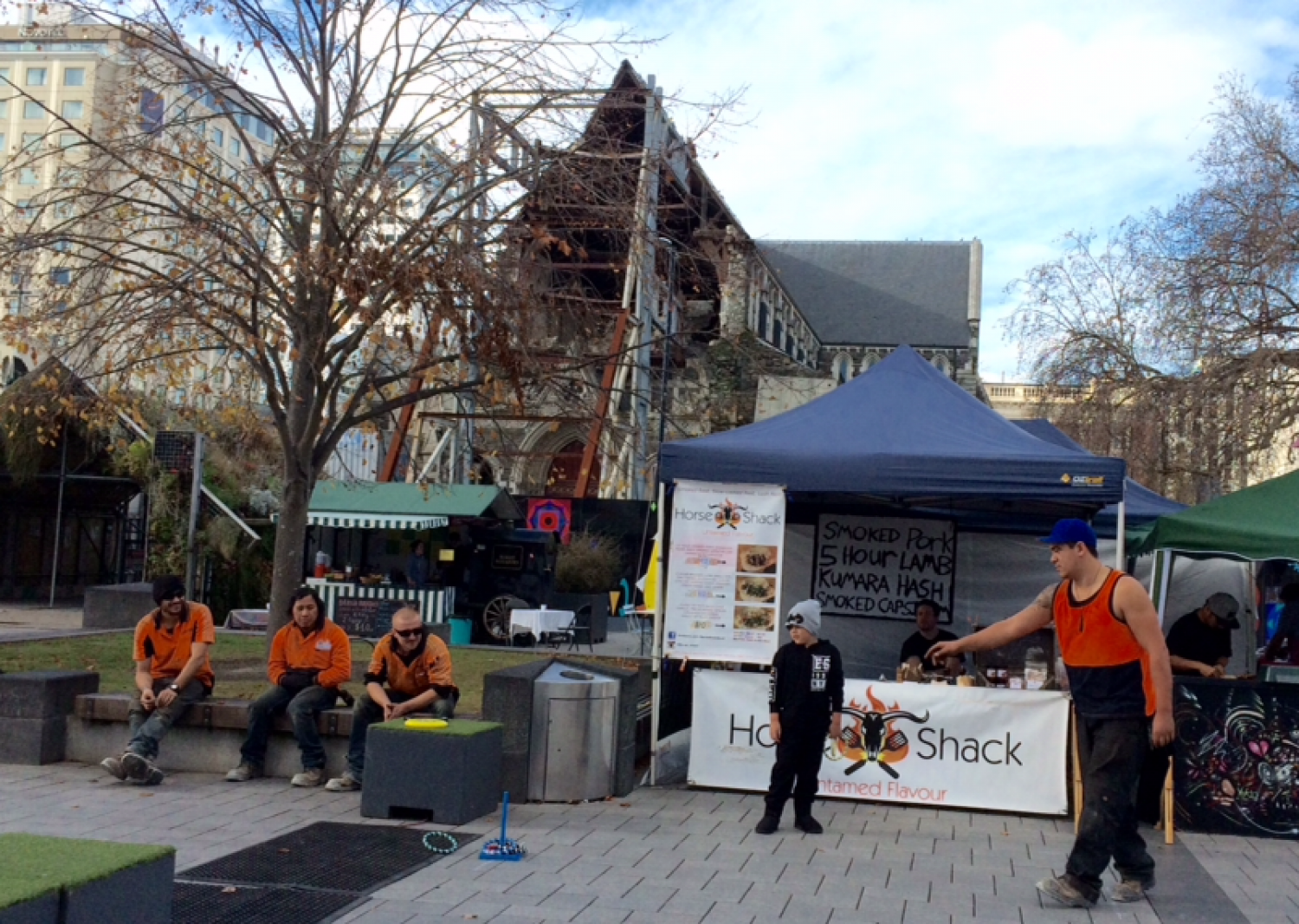
As part of the inner city reinvigoration plan there is a Friday street-food market in Cathedral Square, alongside the tumbled ruins of the once majestic cathedral, so the team makes a point of going along for a coffee and a spot of lunch. We listen to the buskers and sometimes join the other clientele, mainly high-vis-clad construction workers and tradies, in reviving the community spirit with a leisurely round of quoits.

Quoits on a Friday in Christchurch’s Cathedral SquareAntarctic Heritage Trust

Quoits on a Friday in Christchurch’s Cathedral Square

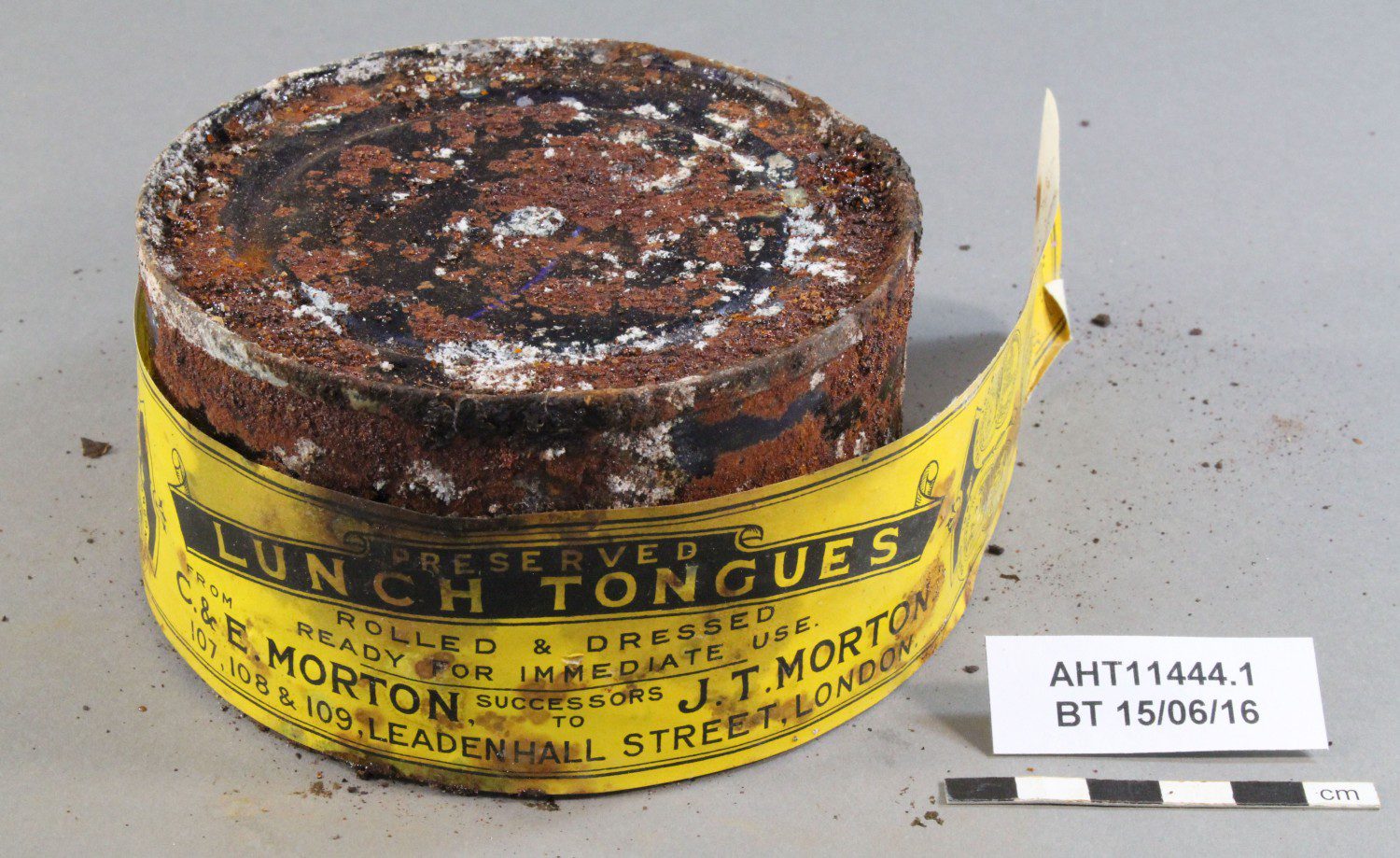
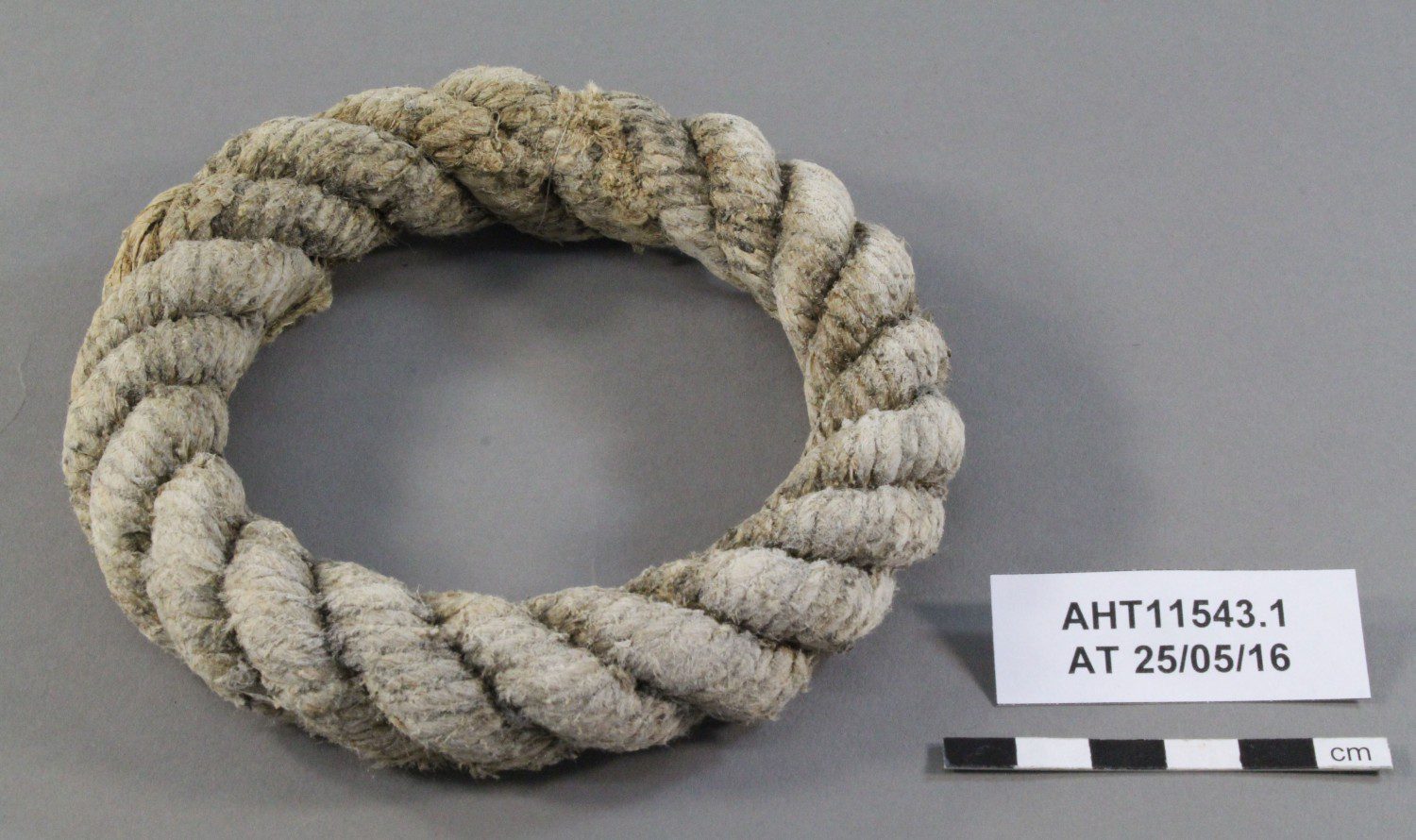
And then it’s back to the lab to conserve … hang on … some century-old coffee, luncheon meat and quoits!  

Packets of historic coffee, 1899Antarctic Heritage Trust

Packets of historic coffee, 1899


Tin of historic preserved lunch tongues, before treatmentAntarctic Heritage Trust

Tin of historic preserved lunch tongues, before treatment


Handmade rope quoit, after treatmentAntarctic Heritage Trust

Handmade rope quoit, after treatment

https://nzaht.org/wp-content/uploads/2019/01/quoits57f189b4dea430.75883595-1500x.png 1067 1500 Comms https://nzaht.org/wp-content/uploads/2019/03/logo-dark.png Comms2016-07-04 00:22:572019-04-30 11:00:38Reinvigorating a City … and History

For Better or Worcestershire Sauce

June 27, 2016 - Antarctic Blog

By Josefin Jimenez

For the past weeks, as the paper conservator, I have been working on a collection of bottles of Lea & Perrins Worcestershire sauce found in the loft of the Southern Cross expedition hut at Cape Adare in Antarctica. Some 30 bottles were found in the loft, in addition to others found in the dining area. Food for the expedition, even if in ample supply, was of little variety and Borchgrevink himself wrote: “Seal beef and roasted penguin flesh became a frequent repast as we grew frightfully tired of tinned food”.

Whether or not this went down well with a dash of Worcestershire sauce remains unsaid.

Lea & Perrins Worcestershire Sauce was established in 1839 so would have been a household name by the time Borchgrevink went to Antarctica. The bottles themselves are beautiful objects and it’s stunning to see them emerge from the debris.

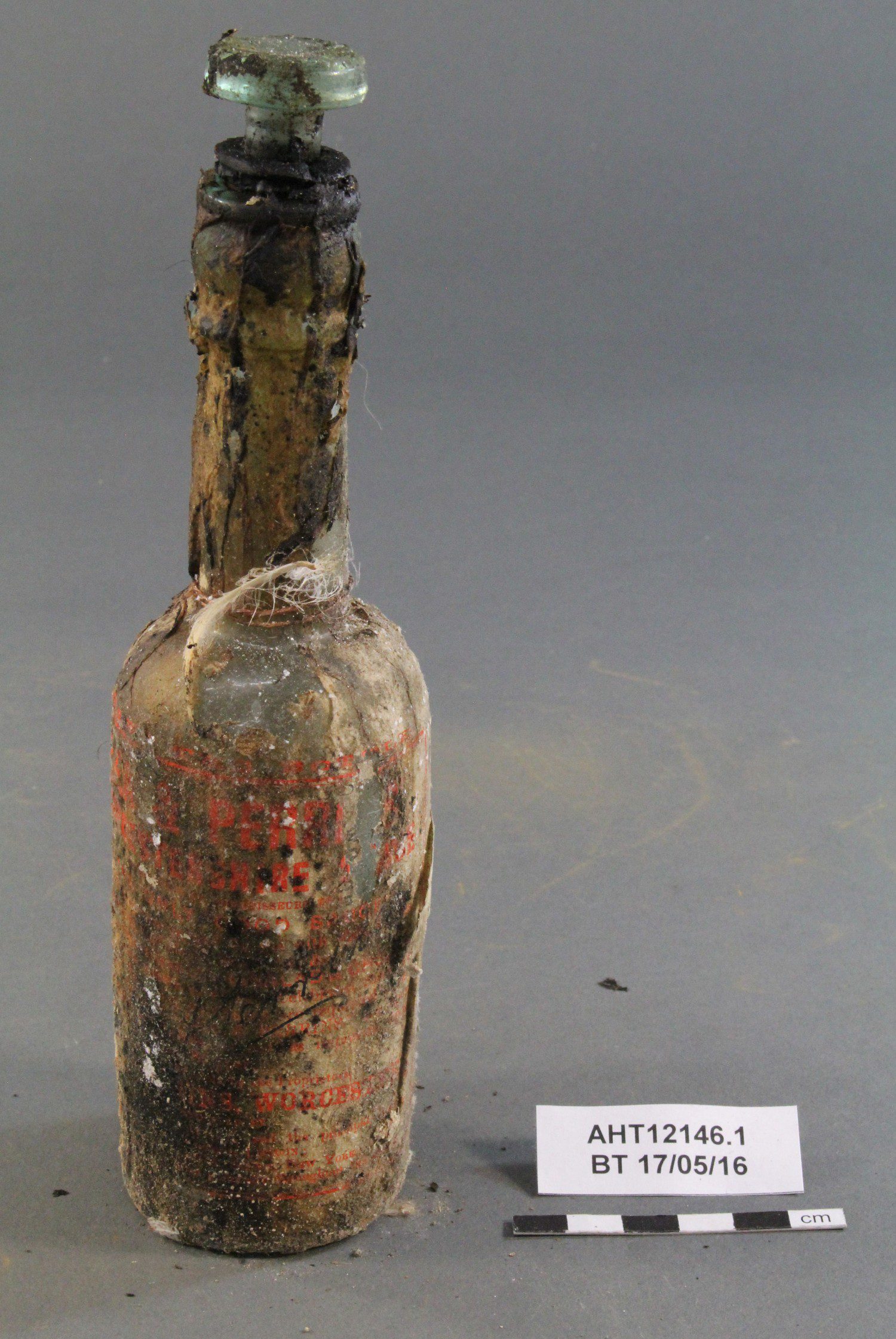
Before treatment image of Lea and Perrins Worcestershire SauceAntarctic Heritage Trust

Before treatment image of Lea and Perrins Worcestershire Sauce

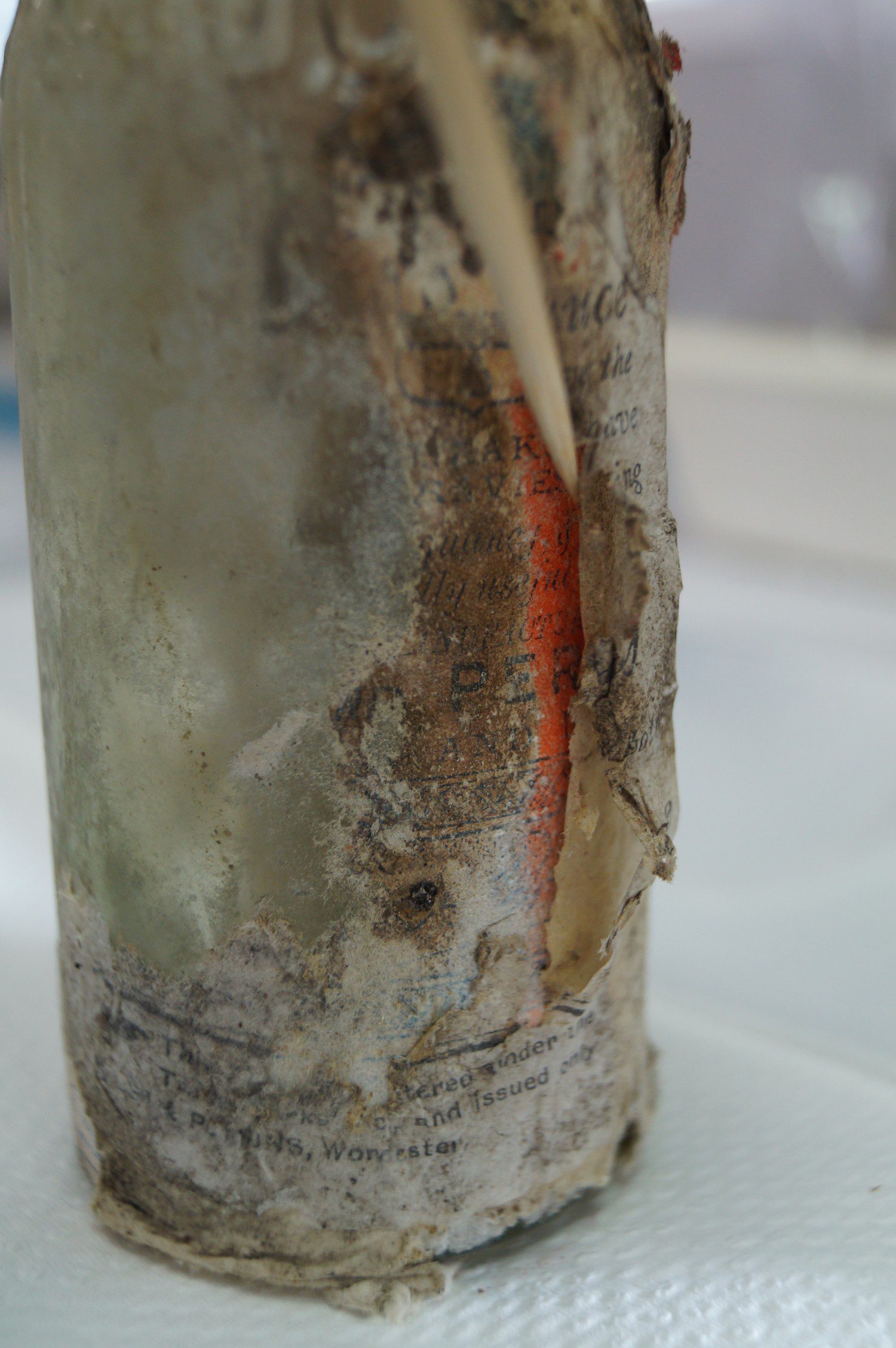
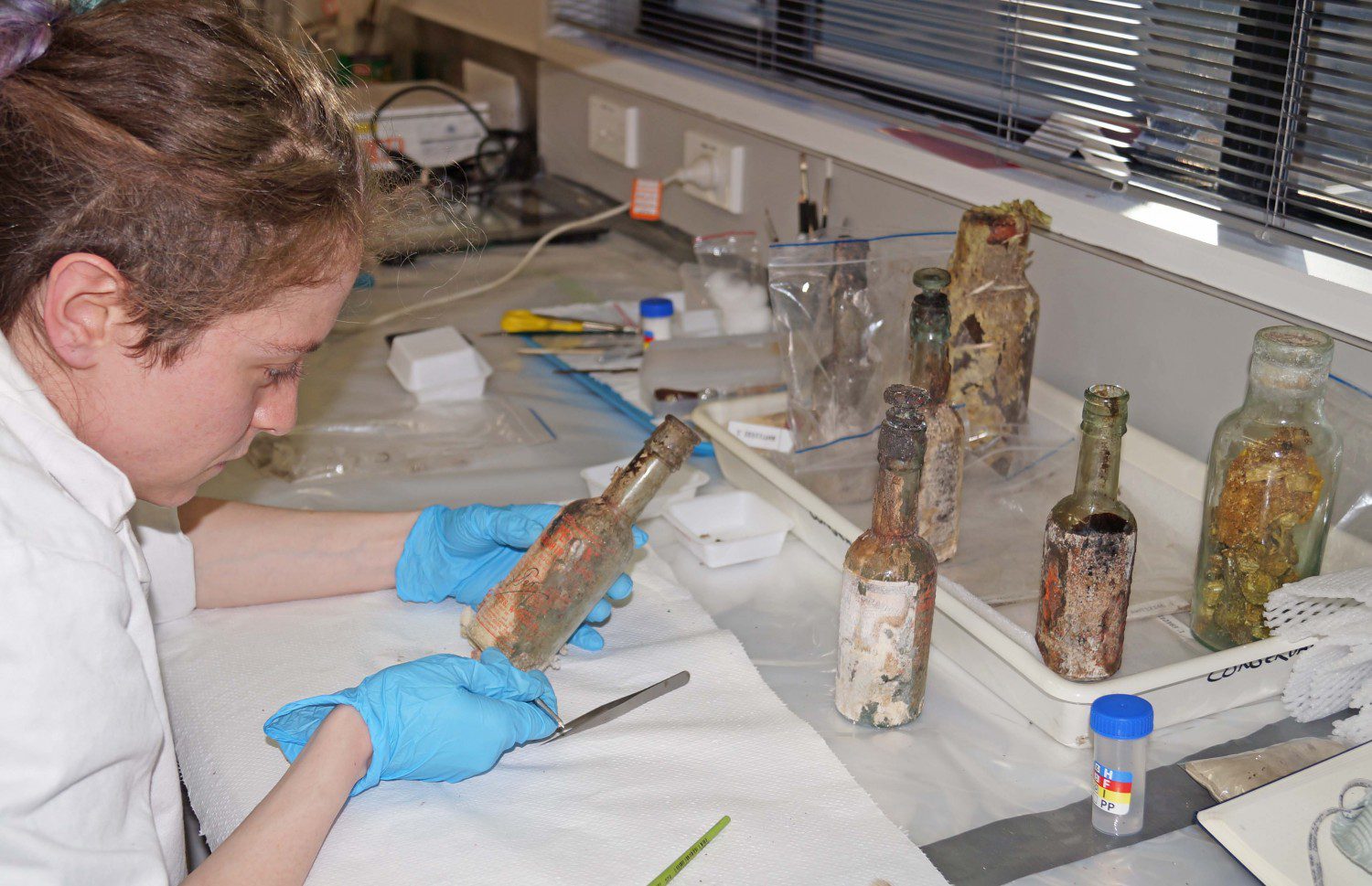
When they arrive to the lab they are covered in grit and penguin feathers and often the sauce has spilled and dribbled from the bottle. Traditionally, the bottles were labelled with a decorative printed label and then wrapped in paper for transport. In some cases only traces of paper remain on the glass; at others, the spills have so impregnated the paper that it is no longer possible to distinguish the paper from the glass.

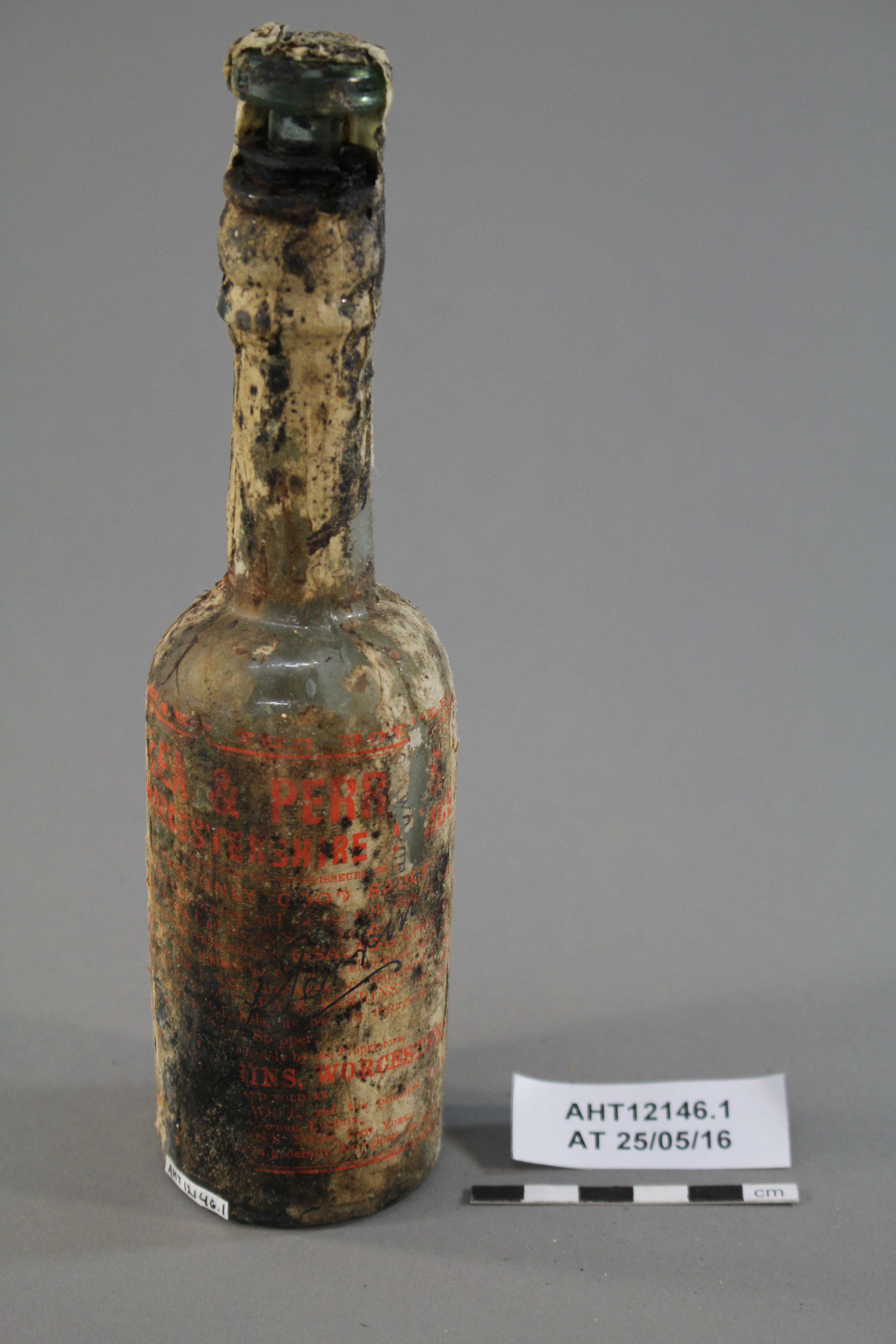
After treatment image of Lea and Perrins Worcestershire SauceAntarctic Heritage Trust

After treatment image of Lea and Perrins Worcestershire Sauce

But for a few of them, where the wrapper has remained, lifting the wrapper reveals a label of startlingly vivid orange colour and delicate blue printing and borders.  Much of the printing is often lost but in good examples the following can be read:

‘Lea & Perrin’s Worcestershire Sauce Pronounced by Connoisseurs as The Only Good Sauce For enriching Gravies, and for use in Game, Steak, Cold Meats, Soup & Curries. It forms an agreeable addition to SALAD & CHEESE. As spurious imitations of this are offered to the public, ensure with each purchase that the name of LEA & PERRINS is on the Wrapper and Labels as well as on each Bottle and Patent Stopper. Manufactured solely by LEA & PERRINS, WORCESTERSHIRE, and sold by CROSSE AND BLACKWELL, and the Warehousemen, London: JOHN DUNCAN’S SONS, NEW YORK, and vendors of sauces generally throughout the world.’

Detail of lifting the wrapper to reveal the label underneath.Antarctic Heritage Trust

Detail of lifting the wrapper to reveal the label underneath.

https://nzaht.org/wp-content/uploads/2019/01/after-treatment-imag57f18fbb7684c0.88858431-1500x.jpg 2250 1500 Comms https://nzaht.org/wp-content/uploads/2019/03/logo-dark.png Comms2016-06-27 00:29:262019-04-30 11:01:53For Better or Worcestershire Sauce

Fighting Fit at 30 Below

June 15, 2016 - Antarctic Blog

By Ciarán Lavelle

The men of Scott’s 1910 expedition would have been at the peak of their physical fitness on the eve of their expedition south. The harshness and physical demands of not just their sea journey but also their time in the icy south required a great deal of both mental and physical strength and stamina to face the trials and tribulations of such a harsh foreboding environment. In our modern fitness and gym-obsessed world it is interesting to think about these virile men and how they organised their own fitness regimes to keep their strength and stamina at the required level.

Antarctic Heritage Trust

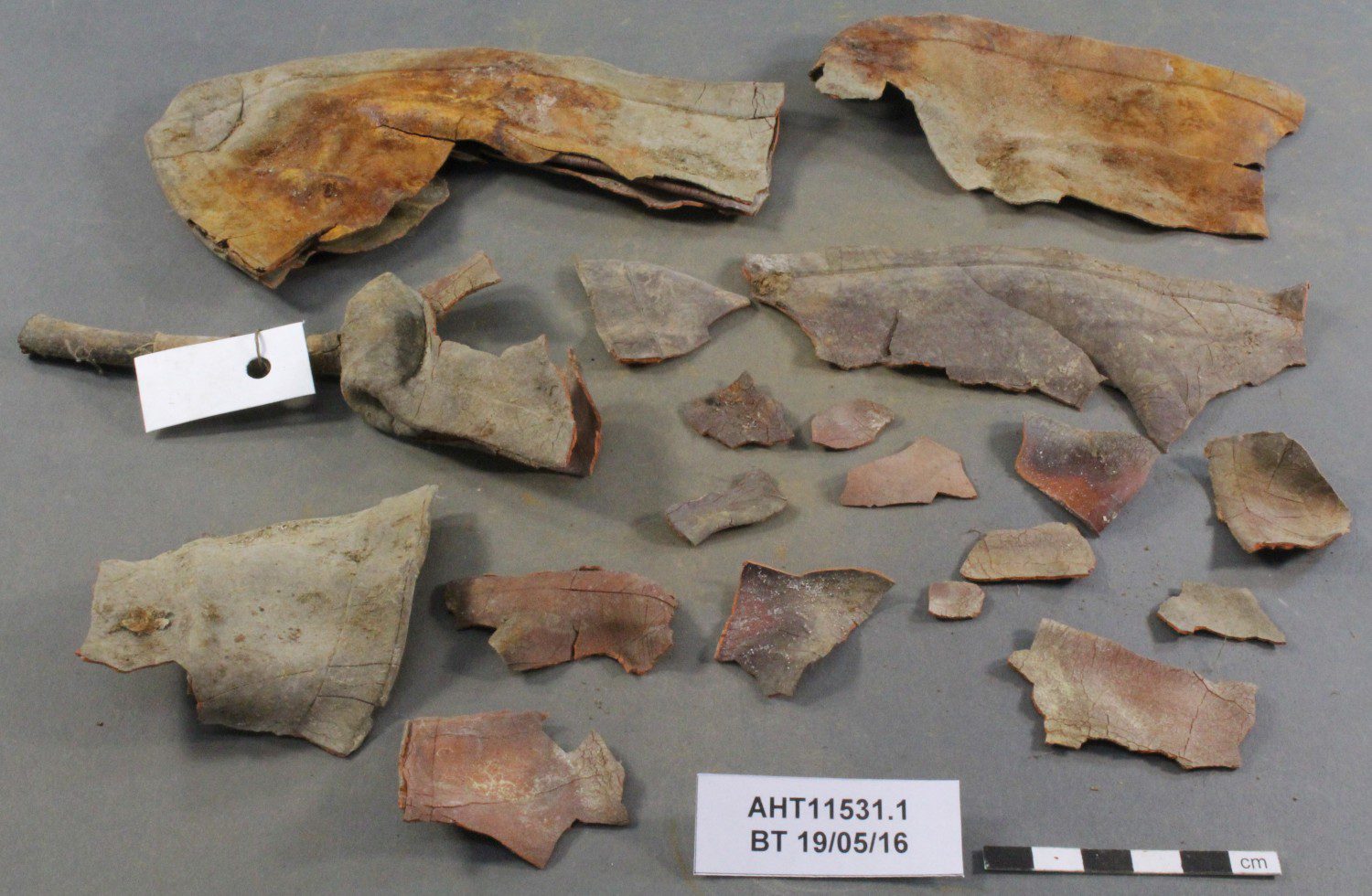
The punching ball before conservation.

This highly degraded rubber object is a fascinating insight into one aspect of their potential fitness regime. Initially documented as being the bladder of a rugby ball it has captured the imagination of the New Zealand Antarctic Heritage Trust team due to the nation’s obvious obsession with the sport. Unfortunately for those rugby enthusiasts among us our initial zeal was dashed as it was discovered that it is not in fact a rugby ball but a punching ball. Renewed excitement followed at the realisation that this may be the very punching ball described in Raymond E Priestley’s personal account of Scott’s Northern Party. Priestley recounts the importance of strenuous exercise for team mate Abbott who turned the old Southern Cross hut into his personal gym for Swedish exercises (our own resident Swedish teammate is still trying to figure out what exactly they are).

Priestley has this to tell us about the ball itself:

‘We had brought a punching-ball with us from the Terra Nova, and for some time this afforded us quite a lot of exercise, but so soon as the temperature fell the rubber of the ball became brittle and useless and a puncture soon followed. It was no use attempting to mend this, and so we did the next best thing. The ball was stuffed with seaweed and from the Gibson Quilting, and though it was very lifeless it was very lifeless it was still of some use.’

Antarctic Heritage Trust

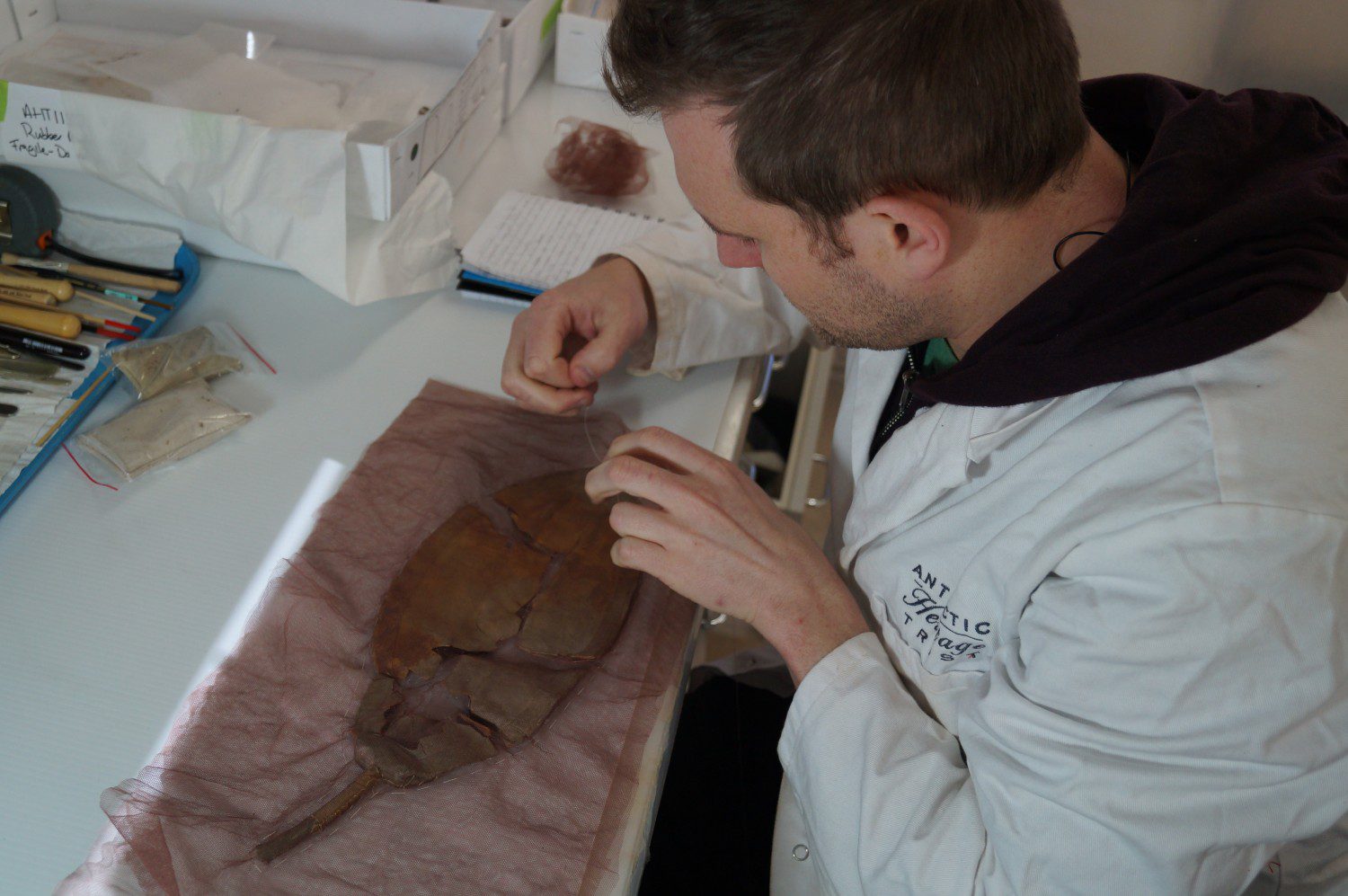
Ciarán creating a protective mount for the punching ball.

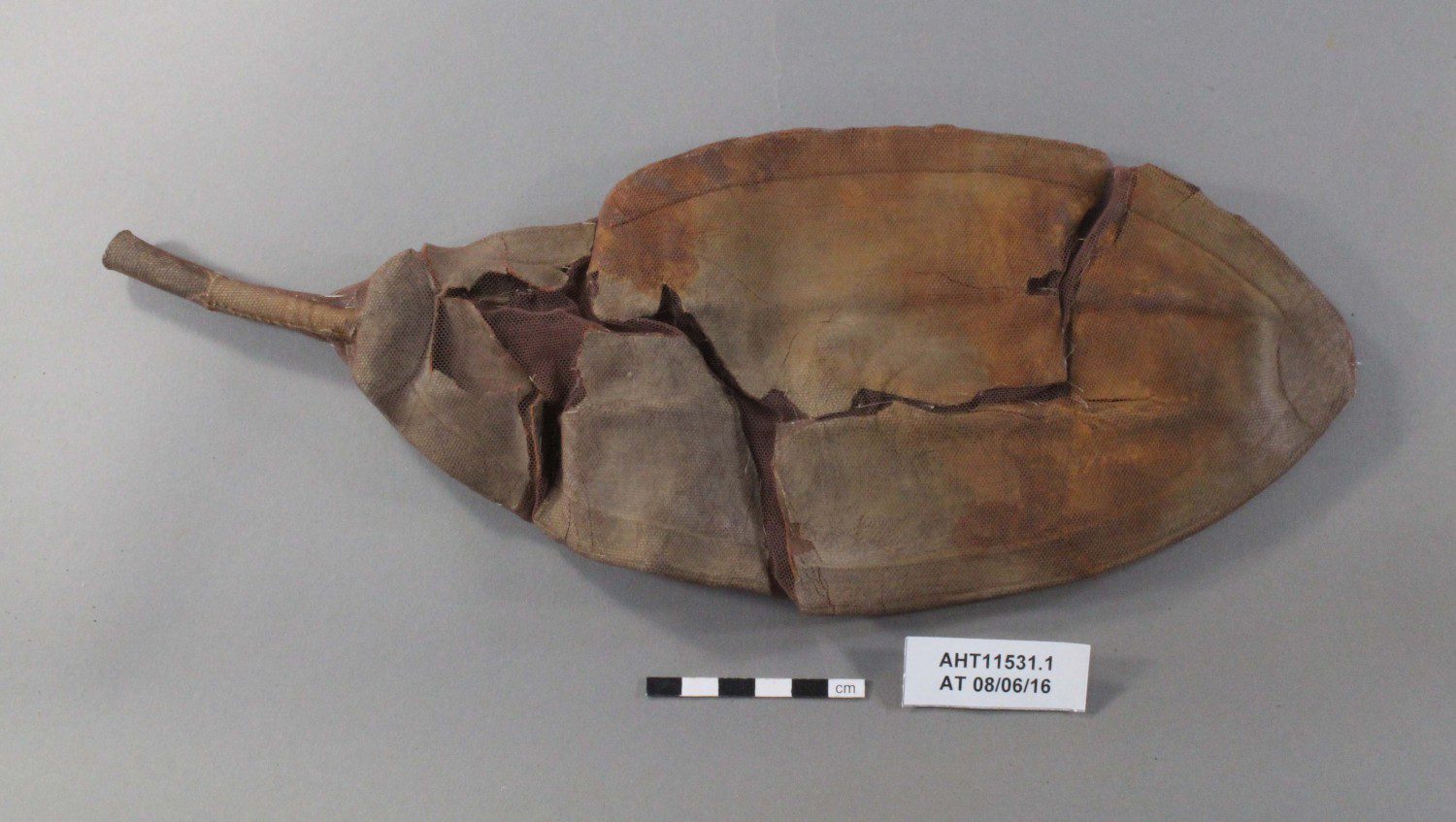
The historical account of the damage the ball has suffered links up with the physical condition of the remaining fragments of the ball. Although the majority of the ball has been lost, what remains is a fragile and brittle jigsaw. The nature of the degraded rubber limits what we can do to the object and since the damage is historical it was decided that stabilisation and display of the object in a way that it can be identified as a punching ball was the best option. The fragments were sandwiched between two layers of a netting and each fragment was sewn into its own individual pocket so as to keep them contained and protected.

The punching ball after conservation.Antarctic Heritage Trust

The punching ball after conservation.

The end result is that we can display the ball in a way that it can be identified while being protected from further loss from fragmentation. Now when I look the ball I can picture fragments of seaweed and rubber falling to the floor as the members of Scott’s Northern Party took their turn to pummel it by candlelight in the gloom of the Southern Cross hut so as to keep fighting fit in the freezing Antarctic cold.

https://nzaht.org/wp-content/uploads/2019/01/the-punching-ball-af57f1846db13d42.48884381-1500x.jpg 847 1500 Comms https://nzaht.org/wp-content/uploads/2019/03/logo-dark.png Comms2016-06-15 00:36:122019-04-30 11:02:38Fighting Fit at 30 Below

A Discovery Below Penguin Guano

June 2, 2016 - Antarctic Blog

By Stefanie White

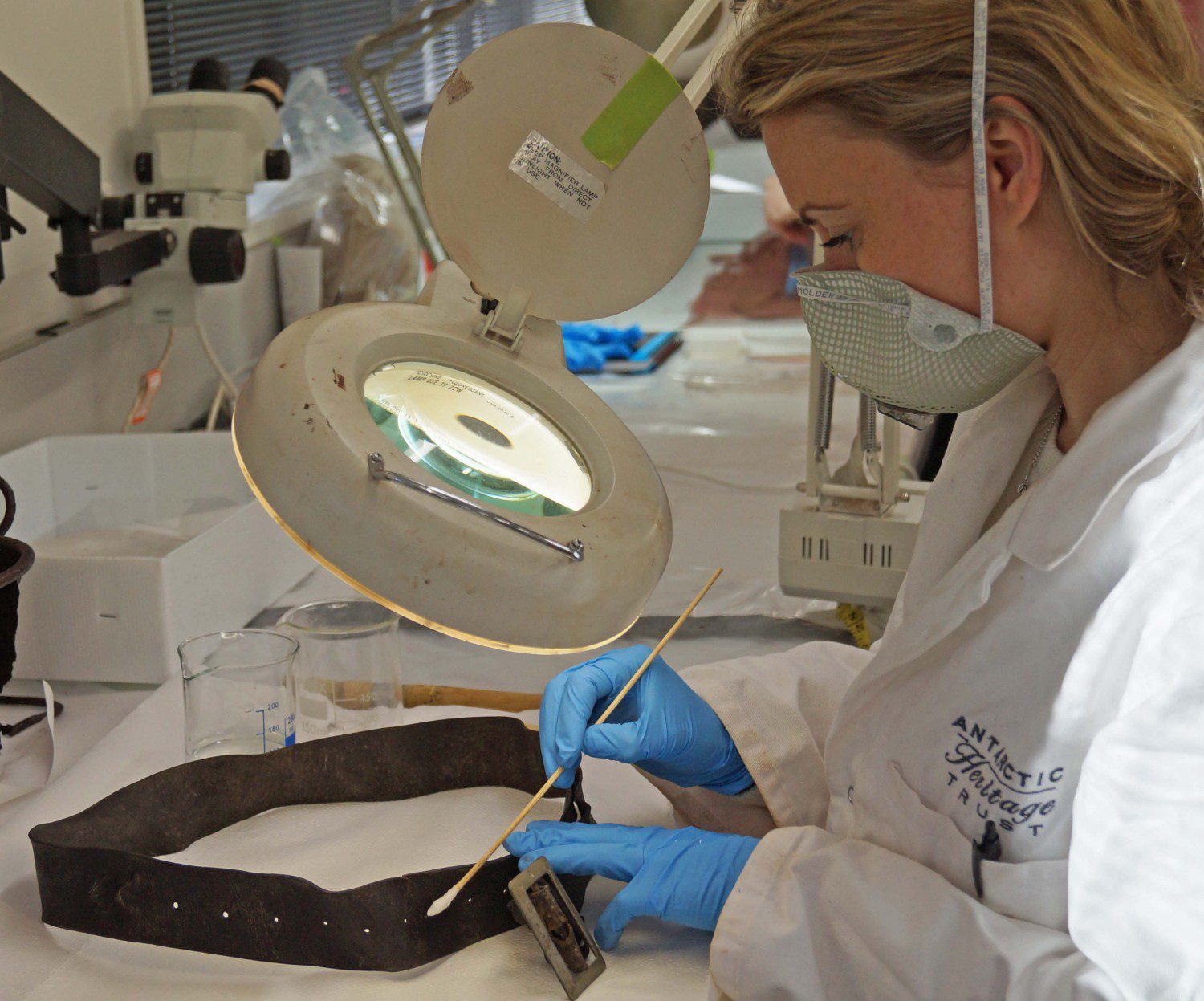
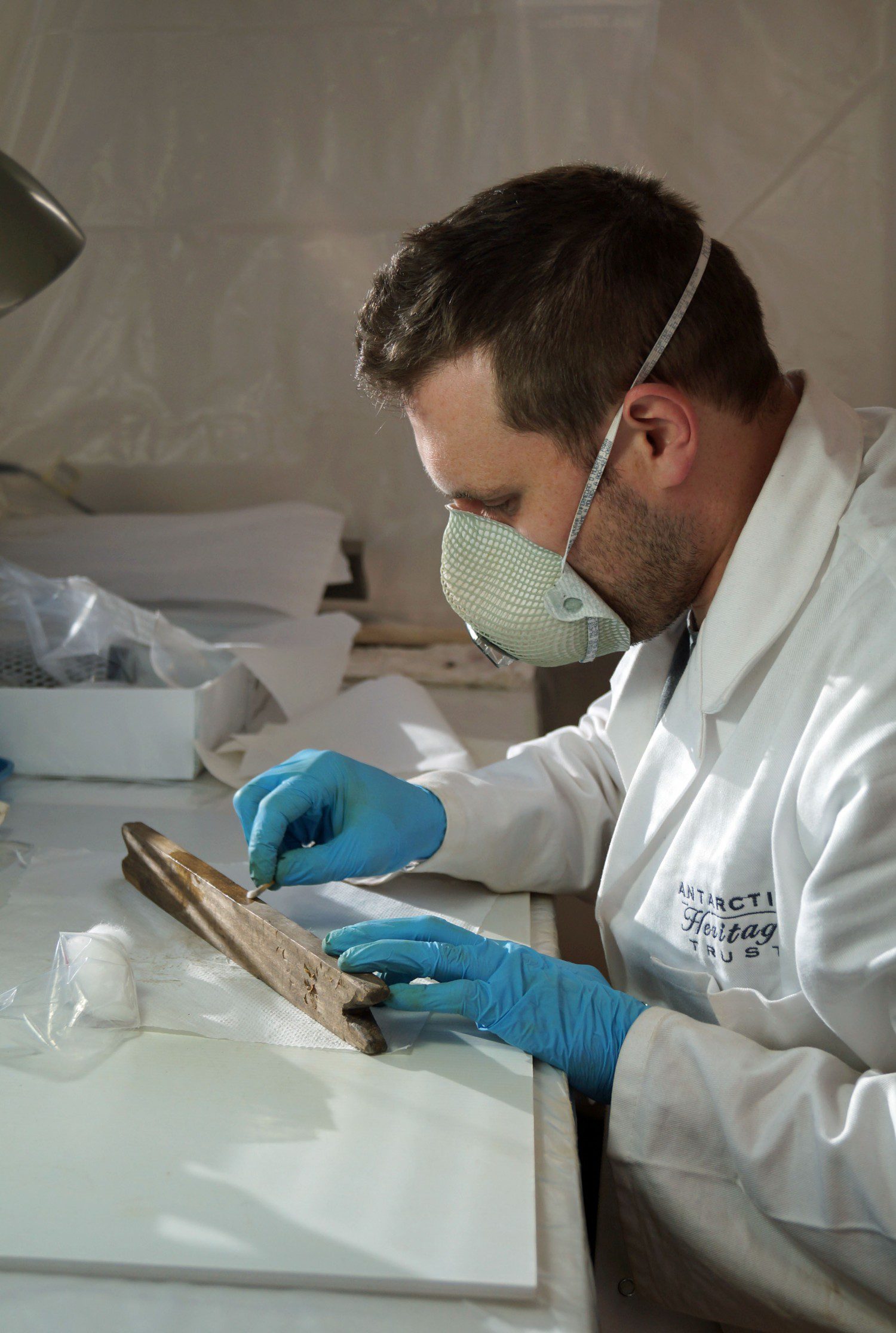
Looking through the magnification lens, I take a breath through my respirator and reach for the micro spatula. The belt is encrusted with layers of dried penguin guano and dirt. It stinks. With the spatula, I lift thin sheets of the encrustations to reveal a stained leather surface. Tweezers hold penguin feathers fast and I remove them from within the encrustation with some force. And then finally I role cotton swabs dampened in deionised water across the leather surface and begin to reveal the original surface. The process is slow, deliberate, meditative and satisfying in that oddly pleasurable way.

Antarctic Heritage Trust

As time passes, I notice the wear marks in the belt and notice which punch hole was used most often. I think about the size of the owner’s waist. I see handmade punch holes and contemplate the dramatic weight loss the owner must have experienced while based at Cape Adare. I think about why the owner left his belt behind … perhaps he forgot it, perhaps he suffered from T3.  The buckle is interesting. It’s square, elegant and made out of nickel.

Antarctic Heritage Trust

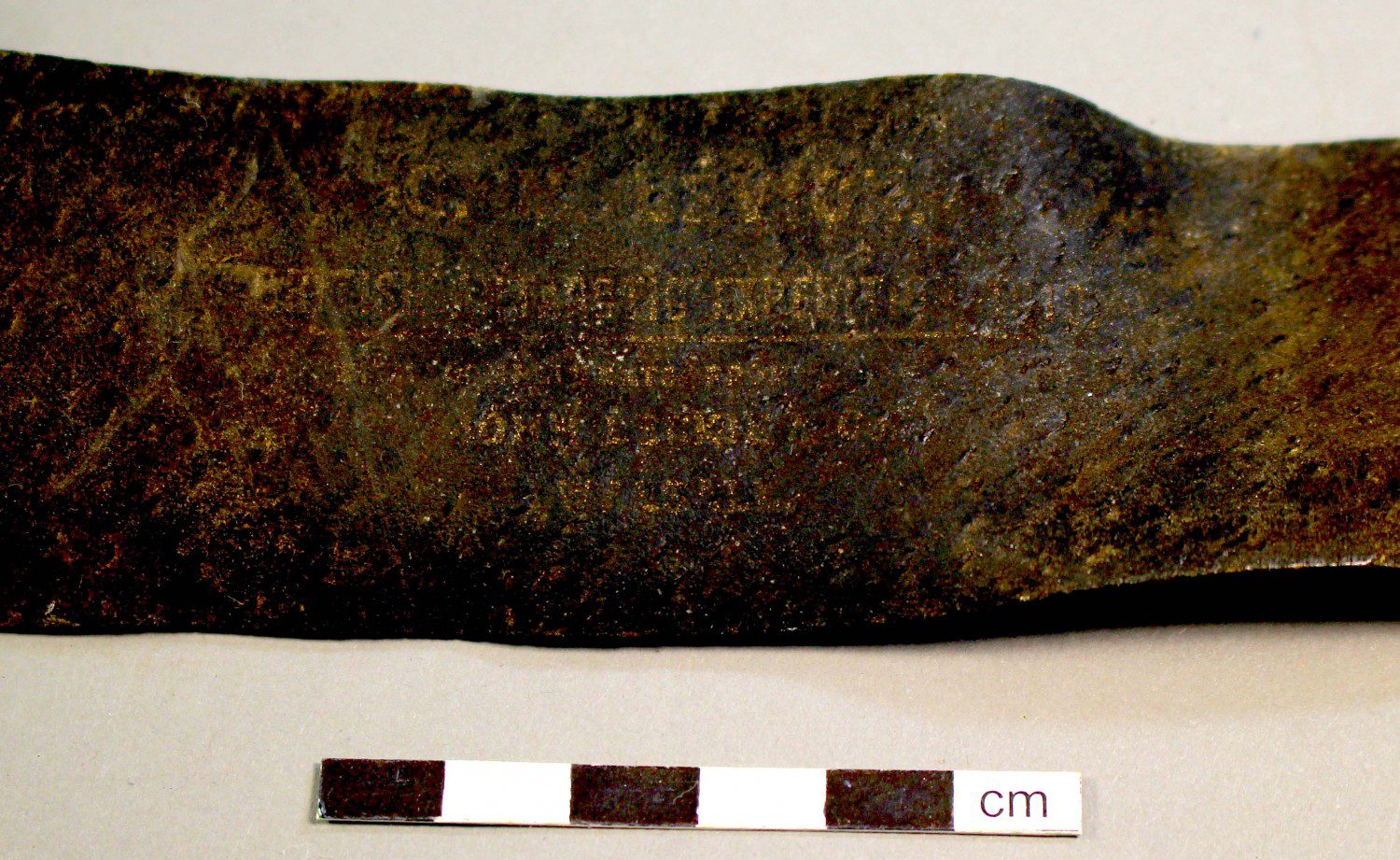
As I swab, I tune into the New Zealand radio playing in the background and into conversations happening in the lab. I continue to swab and swab and swab the leather belt. And then from beneath the residue of the penguin guano, I see something. I see a gold printed letter. I turn and shout to my colleagues ‘The owners name is on the belt’ and together we decipher the printed letters.

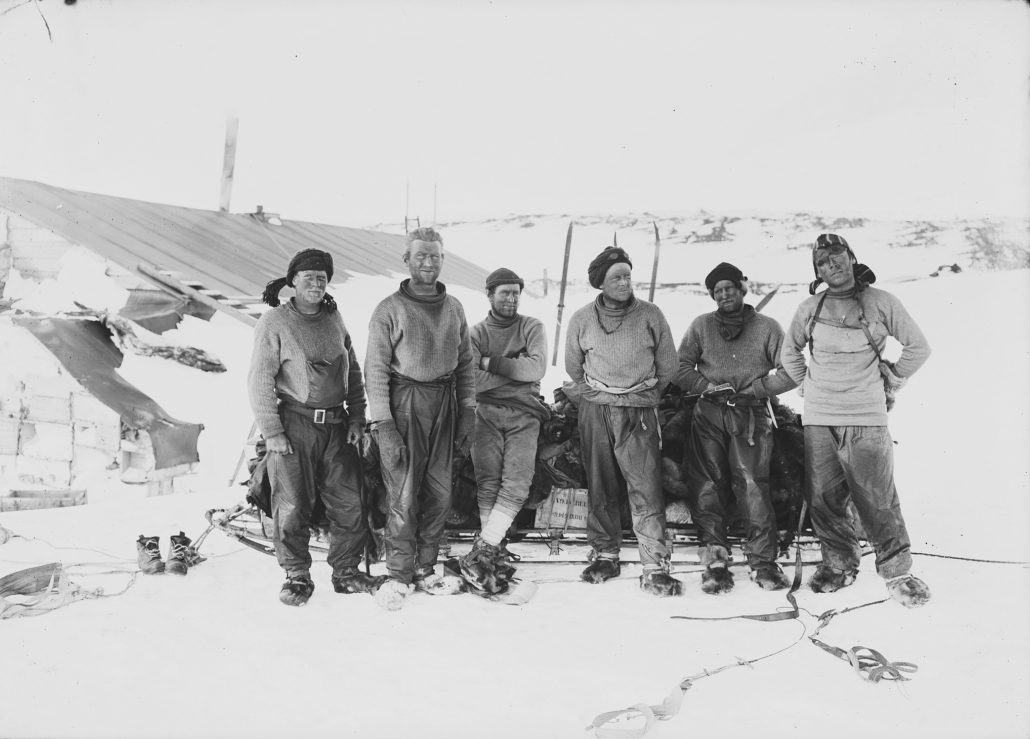
George Murray Levick was a naval surgeon and zoologist on Scott’s Terra Nova Expedition of 1910-13. Being a part of the Northern Party, he spent the summer of 1911-1912 at Cape Adare.  Levick and possibly all members of the Terra Nova expedition were gifted a leather belt by the leather manufacturing company Leckie and Co. based in Walsall, England. They received this gift especially for this British Antarctic Expedition. The discovery of the gold printed letters was a highlight this week in the lab. The discovery is one-of-a-kind as no other belt survives. Information previously unknown was uncovered and it’s always exciting for a conservator to be able to attribute an owner’s name to an artefact.

Scott's Northern Party return to Cape EvansCanterbury Museum

Northern party on arrival at Cape Evans, 7 November 1912. Photographer: Frank Debenham. British Antarctic Expedition, 1910-13

https://nzaht.org/wp-content/uploads/2019/01/levick-belt57f17d3f4dfc02.92283709-1500x.jpg 921 1500 Comms https://nzaht.org/wp-content/uploads/2019/03/logo-dark.png Comms2016-06-02 00:41:342019-04-30 11:03:29A Discovery Below Penguin Guano

Meet the Team – Cape Adare Artefacts Conservation Project

May 24, 2016 - Antarctic Blog

By Josefin Jiménez

The work to conserve the artefacts from Cape Adare, the base established by Carsten Borchgrevink’s British Antarctic Expedition (Southern Cross) 1898 ̶ 1900, has just begun. Due to Cape Adare’s inaccessible location the artefacts won’t be conserved on the ice at Scott Base this winter but have instead been frozen and transported to Christchurch for treatment.

The team is made up of four conservators, some of whom are old hands with AHT and some of whom are new faces.

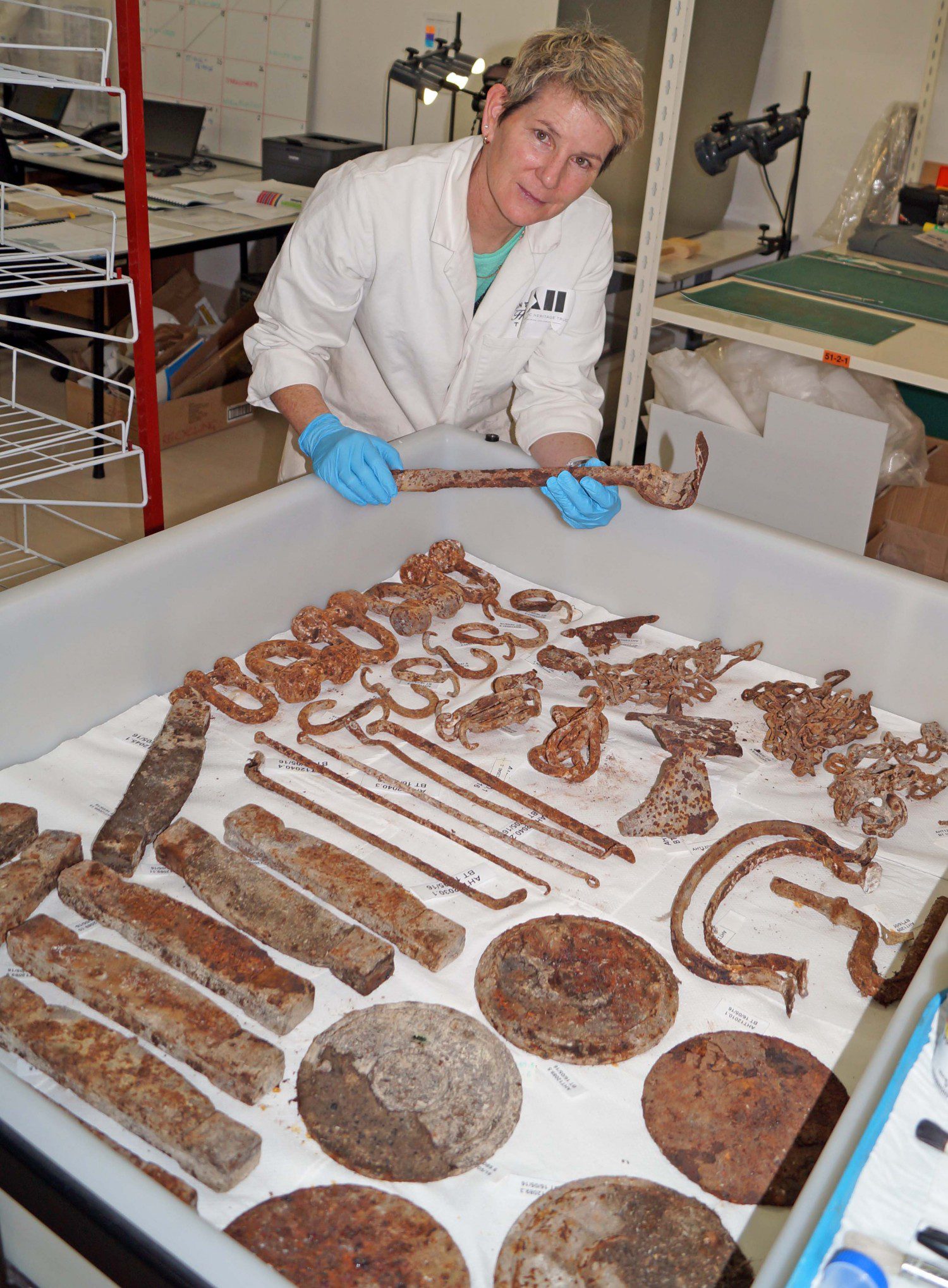
Sue Bassett, lead conservator, has led AHT Winter teams through 2013 and 2014, has experience with many interesting conservation projects in Australia and elsewhere, and has a passion for Antarctic history.

Antarctic Heritage Trust

Sue has selected the first batch of iron alloy objects that will undergo desalination! Objects include stove parts, dog chains, hooks and shackels.

Stefanie White, objects conservator, has also wintered in Antarctica twice before, working with AHT in 2013 and 2014 on objects from Captain RF Scott’s Discovery hut and Terra Nova hut.

Antarctic Heritage Trust

The newcomers to the Trust are Ciarán Lavelle, objects conservator, and Josefin Jiménez, paper conservator. Both have been following the project with interest for some time and are delighted to join the team. 

Antarctic Heritage Trust

Ciaran Lavelle


Josefin conserves the deteriorated labels on bottles of pickel and L&P's worcestershire sauceAntarctic Heritage Trust

Josefin conserves the deteriorated labels on bottles of pickel and L&P’s worcestershire sauce

Surprisingly the team has a strong Irish connection as both Stefanie and Ciarán are Irish and Josefin, albeit Swedish, has been living and working in Dublin for a year before coming to New Zealand.

It is going to be an exciting year with many fantastic objects to uncover. It is already amazing to see the new objects emerge and, as Borchgrevink’s hut is located in the middle of the world’s largest Adelié penguin colony (population 750,000), some of them are quite literally emerging … from vague shapes covered in guano and feathers, into recognisable historic artefacts (with a very distinct aroma).

https://nzaht.org/wp-content/uploads/2019/01/ciaran-working57f1763aaa27c9.45445781-1500x.jpg 2232 1500 Comms https://nzaht.org/wp-content/uploads/2019/03/logo-dark.png Comms2016-05-24 01:05:112019-04-30 11:16:53Meet the Team – Cape Adare Artefacts Conservation Project

Favourites

February 22, 2016 - Antarctic Blog

By Sue Bassett

During the decade of work by the Trust’s on-ice conservation teams, many personal insights have been gained into the lives of the early expeditioners. Some of the paper items from Captain RF Scott’s hut at Cape Evans provide good examples.

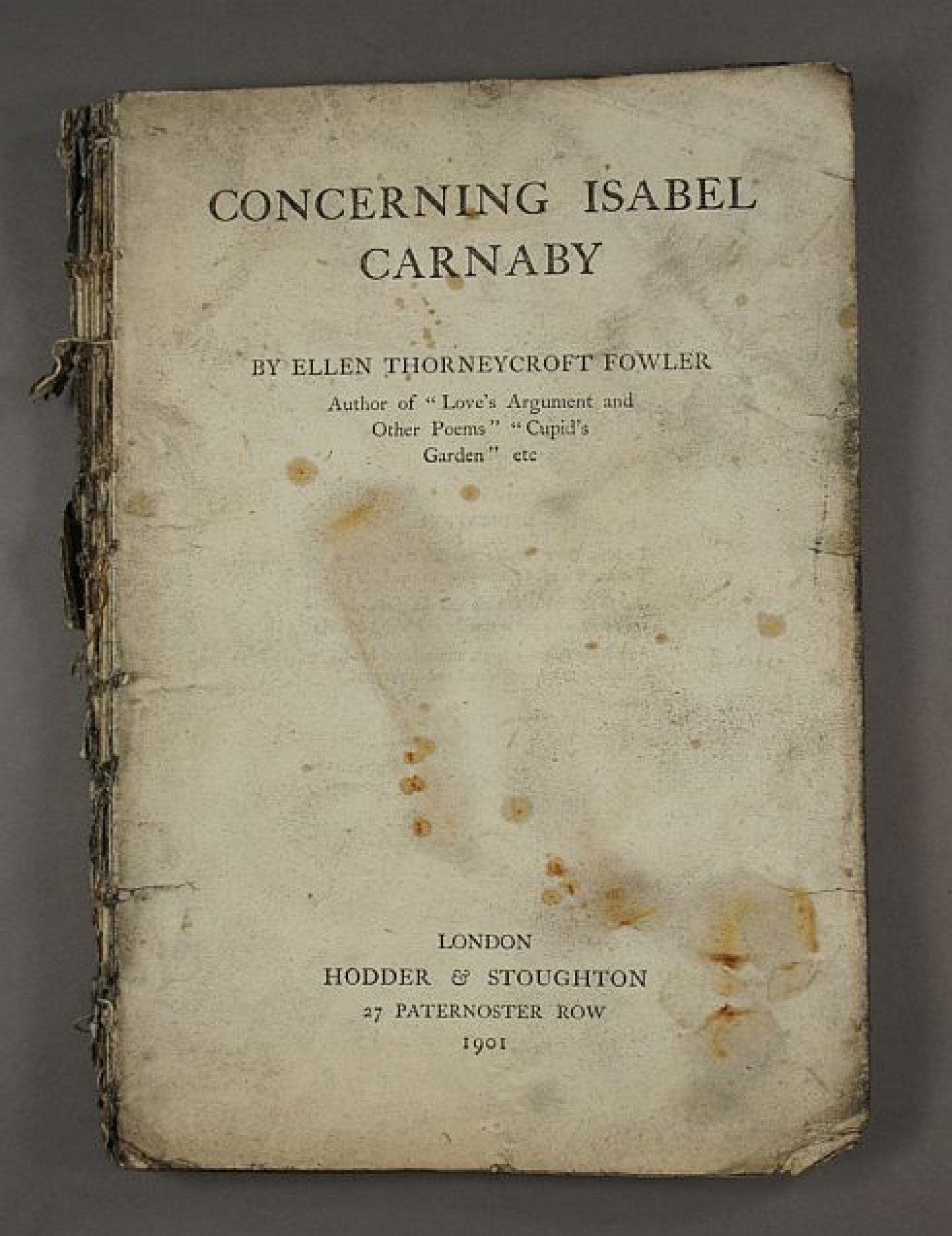
In addition to a range of adventure stories and military novels, there are a surprisingly large number of paperback romances … and, judging by the degree of wear and sooty fingerprints, they were rather well read!

The stories seem to reflect the sensibilities of the era and are of variable quality – although almost all seem to feature prolonged bouts of blushing between the chief protagonists. One of the best (or worst) involves a hero called Dr Love who finds he has feelings for an impoverished actress and resolves to free her from the profession. The end pages are unfortunately missing, so we can only hope that it ends as a proper romance should.

Antarctic Heritage Trust

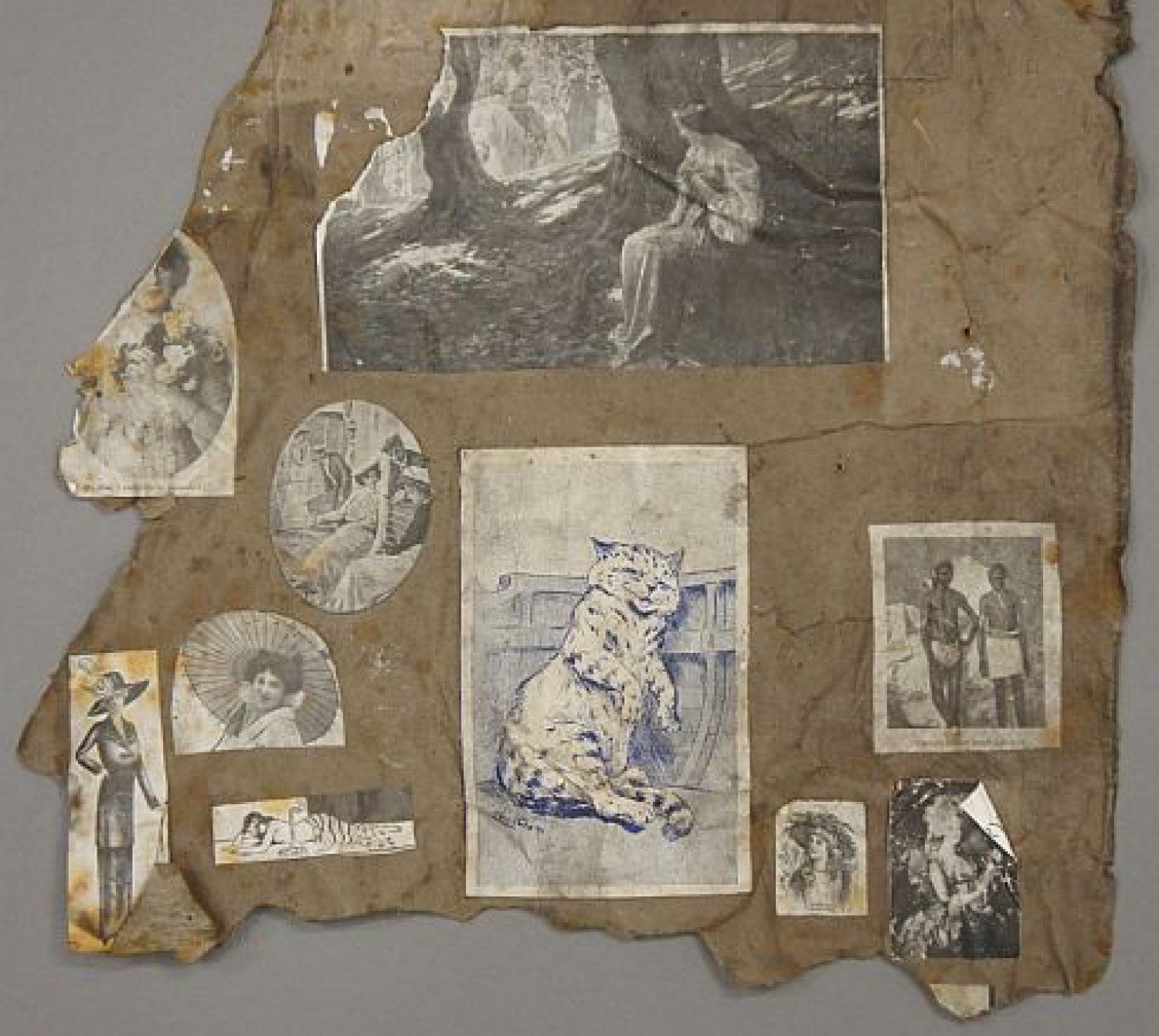
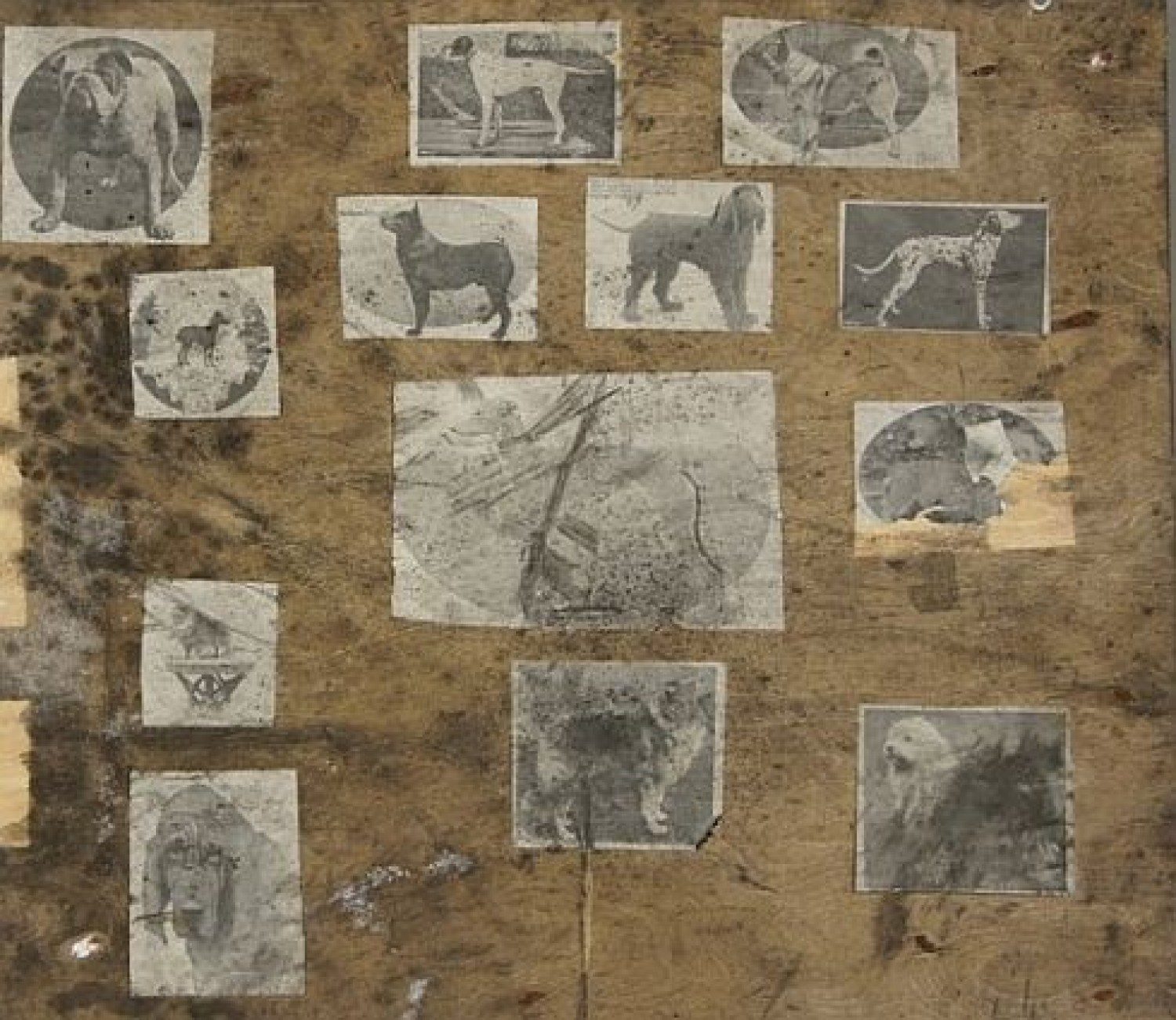
Many of the magazines, too, combine stories of popular interest with the frivolous and banal (not to mention articles on fashion for the ladies). To Scott’s men, who often had to survive gruelling conditions, such throwaway reading matter was likely valued as a diversion. Along the same lines are two scrapbook-style montages tacked to the wall in the officers’ sleeping area. One comprises a wonderful selection of images—all cut from magazines—mainly of women with big hats, parasols and big hair, all surrounding a large central image of a very well-fed cat. The other, a firm favourite of ours, is a collection of cut-out pictures of dogs pasted to the back of a plywood crate lid … presumably by someone very fond of man’s best friend and perhaps also missing his pooch back home.

Antarctic Heritage Trust
https://nzaht.org/wp-content/uploads/2019/01/scotts-hut-cape-evan56a00c434172a9.73969369-600x600.jpg 600 600 Comms https://nzaht.org/wp-content/uploads/2019/03/logo-dark.png Comms2016-02-22 01:12:452019-04-30 11:19:42Favourites

Dogs

October 28, 2015 - Antarctic Blog

By Sue Bassett

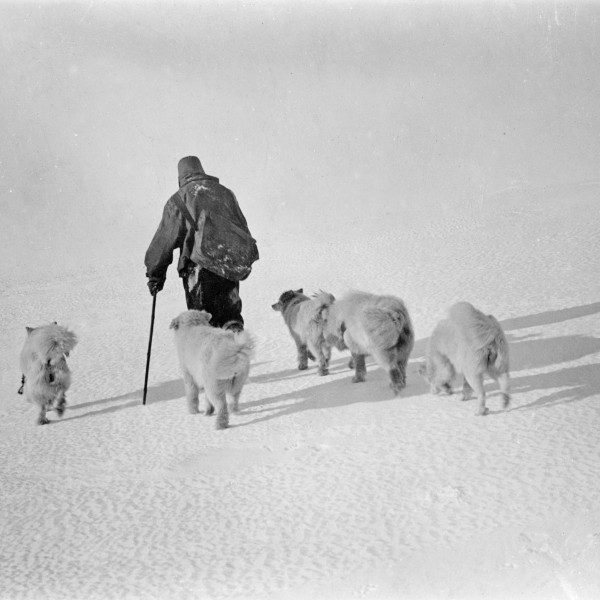
While Captain RF Scott wasn’t keen on the idea of using dogs as his main means of transport to the South Pole—largely because of the cruelty and sacrifice involved—he did take a team of 35 sledging dogs (and a collie bitch, ‘Lassie’) to Antarctica on his 1910–13 expedition.

Antarctic Heritage Trust - dogsRoyal Geographical Society

Antarctic Heritage Trust – dogs

The sledging dogs were collected in Siberia, moved by dog-driver to Vladivostok, and transported by steamer to Lyttelton, New Zealand, via Sydney, to be loaded onto the ‘Terra Nova’ for the 5-week voyage to Antarctica. There they lived in the expedition hut’s stables at Cape Evans under the control of their handler, CH Meares. Each had a name and their antics, personalities, highs and lows are referred to frequently in Scott’s journals.

Later, Ernest Shackleton’s 1914–17 Ross Sea support party also had a small team of dogs at the hut. Ten members of the expedition were marooned at Cape Evans when their ship, ‘SY Aurora’, still containing most of their supplies and equipment, broke anchor and was swept away from shore. Ernest Joyce, who was the leader of the sledging party, and his team relied heavily on their surviving dogs to bring their weakened scurvy ridden bodies home after their journey across the Ross Ice Shelf to lay depots of stores.

Samson, one of the dogs that went to the ice with Shackleton's Ross Sea Party.Cantebury Museum

Samson, one of the dogs that went to the ice with Shackleton’s Ross Sea Party.

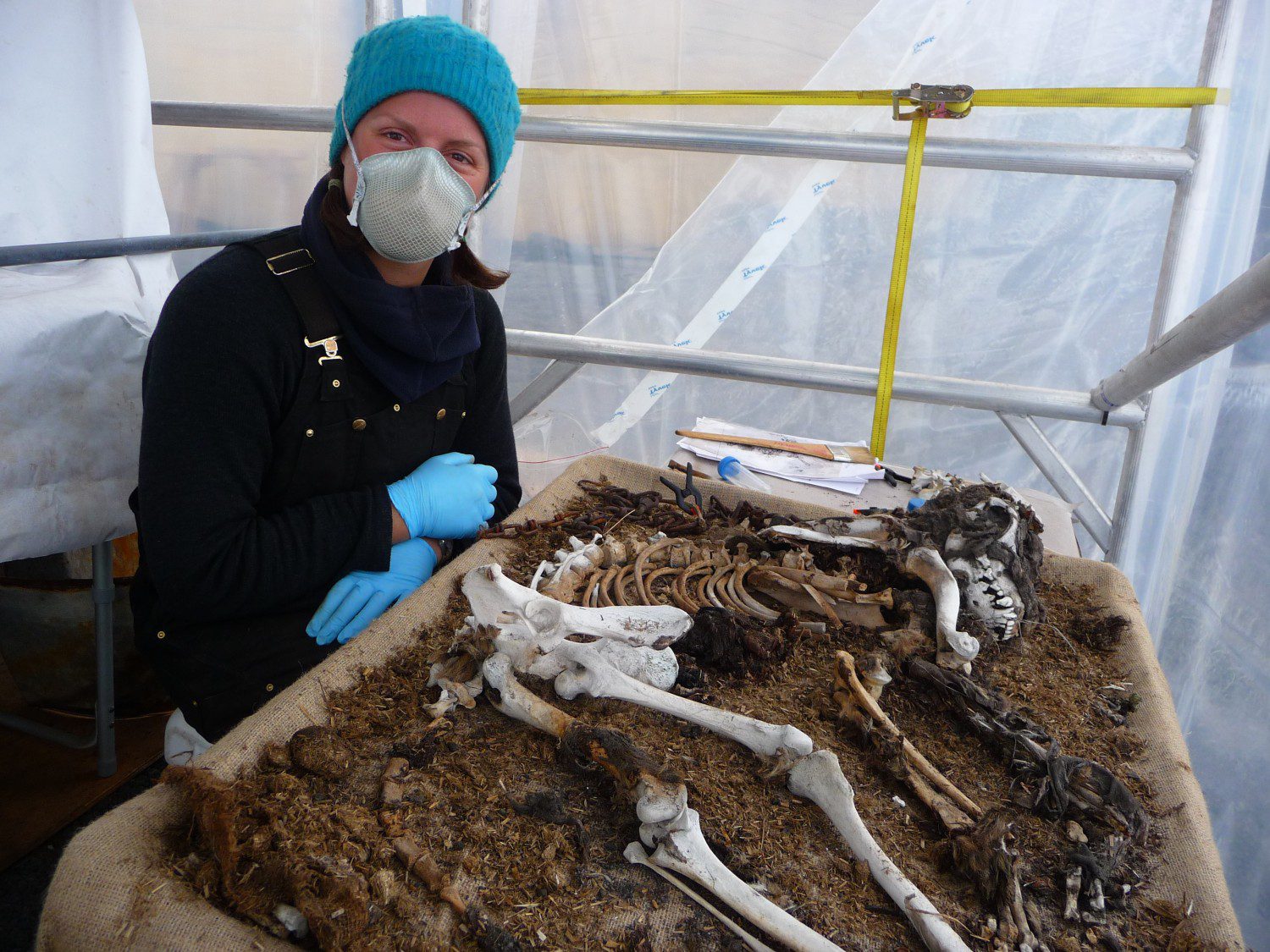
Nearly a century later, the degraded body of an unidentified sledging dog from one of these expeditions still lay chained to the northern wall outside the stables at the Cape Evans hut. There are photographs of the dog from the 1950s, when it was desiccated but still largely articulated within its coat. Since then, the ravages of the elements and disturbance by opportunistic skuas – scavenging seabirds, which live in abundance around Cape Evans – have resulted in decay and loss of the dog’s flesh and skin, and disarticulation and scattering of exposed skeletal material.

During the Trust’s recent work to carry out essential repairs to the stables, the dog’s remains were re-excavated and moved. As a protection against further deterioration, they were relocated inside the stables and laid out in one of the pony stalls. The dogs of both Scott’s and the Ross Sea Party’s expeditions were usually allowed to roam freely around in the stables so it is a fitting final resting place.

Lucy conserves the skeleton of a husky from the Ross Sea Party at Cape Evans. Antarctic Heritage Trust

Lucy conserves the skeleton of a husky from the Ross Sea Party at Cape Evans. The skeleton was re-associated after several years of meltwater and wind erosion had begun to scatter the bones.

https://nzaht.org/wp-content/uploads/2019/01/dogs56cb7dd164c778.30918159-600x600.jpg 600 600 Comms https://nzaht.org/wp-content/uploads/2019/03/logo-dark.png Comms2015-10-28 01:21:552019-04-30 11:29:43Dogs

Midwinter

June 18, 2014 - Antarctic Blog

By Sue Bassett

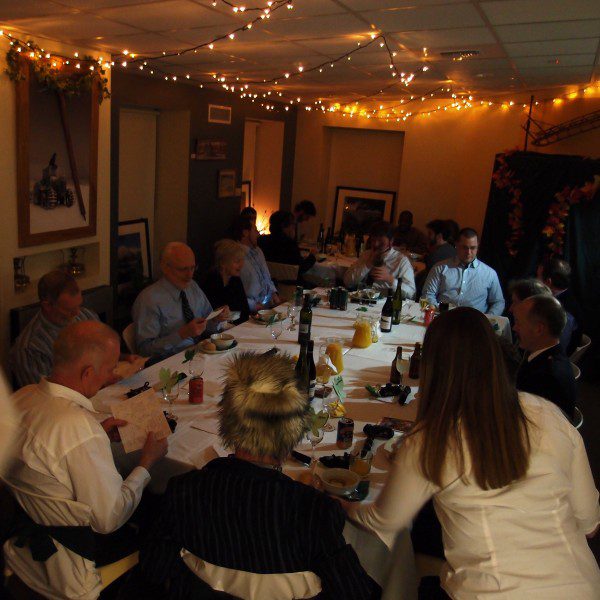
Midwinter is upon us, for those in the southern hemisphere at least. For those of us in Antarctica, midwinter is traditionally a time of celebration and feasting. We’ve reached our shortest day—our darkest day—and now we move towards the return of the light and the return of the sun in a couple of months’ time. Definitely a milestone to be celebrated!

Antarctic Heritage Trust - midwinter

Antarctic Heritage Trust – midwinter

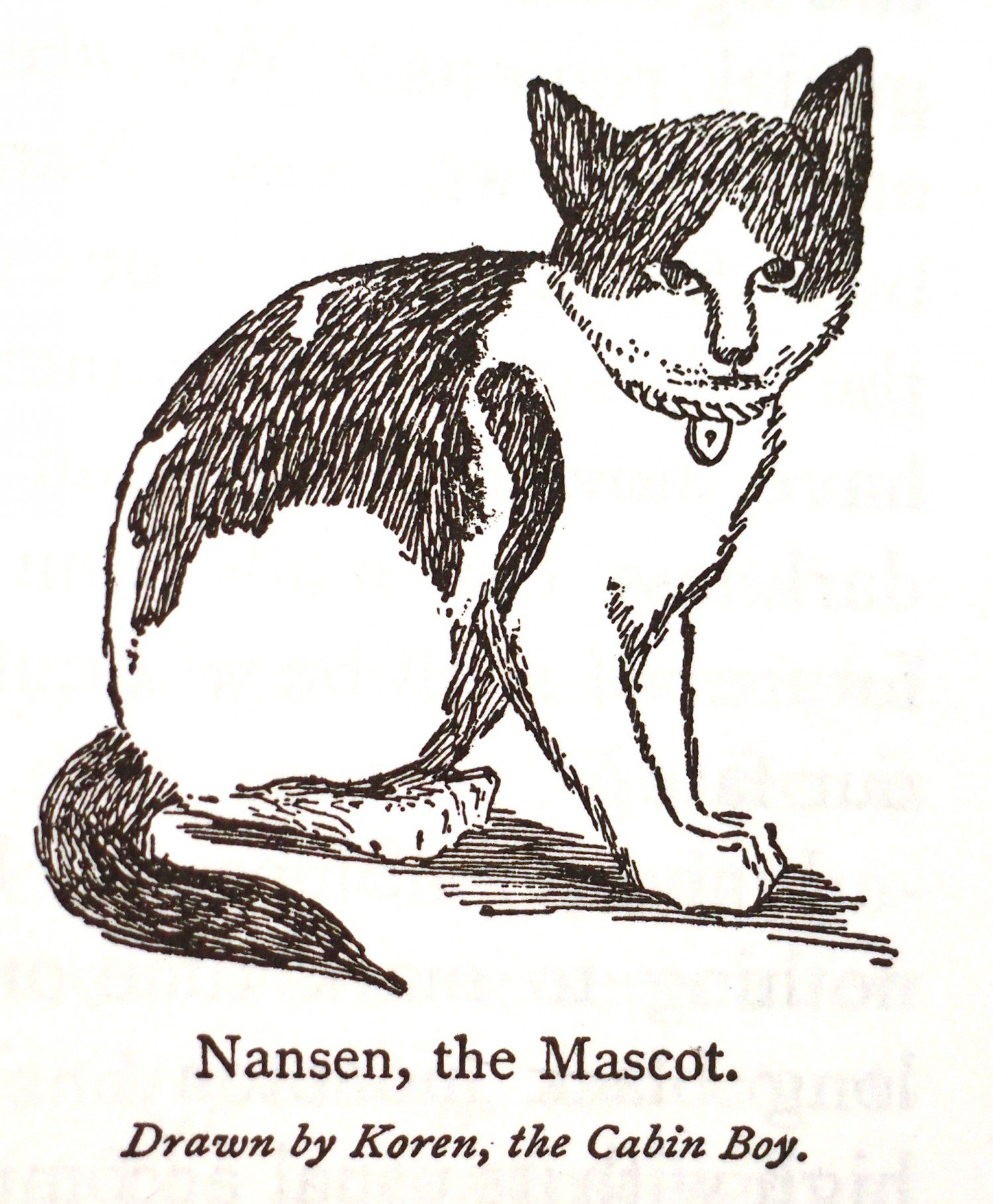
But where did this ‘tradition’ begin, on a continent with a very short history? Certainly not with the members of the Belgian Antarctic Expedition who, in 1898, became the first expeditioners to winter in Antarctica after being trapped in the ice aboard their ship ‘Belgica’. For them it was all doom and gloom, with tales of ‘dreary, cheerless days’, of hardship, extreme discontent, illness and tragedy. Midwinter was described as ‘the darkest day of the night; a more dismal sky and a more depressing scene could not be imagined’. And, to add ‘another cloud to the hell of blackness’, their beloved cat, Nansen, succumbed to the long darkness at midwinter, and died.

Nansen, the 'Belgica' catCredit unknown

Nansen, the ‘Belgica’ cat

The midwinter tradition should probably be credited to Robert Falcon Scott, who on his first expedition just four years later describes the festivities of midwinter 1902 in some detail. There were decorations ‘with designs in coloured papers and festooned with chains and ropes’ and ‘the tables were loaded with plum puddings, mince pies, and cakes’. There were speeches, presents, sing-songs, champagne, and great revelry, with which, Scott records, ‘we agreed that life in the Antarctic regions was worth living’.

As we at Scott Base hung the decorations, opened gifts and tucked into our 9-course midwinter dinner, shared with some good friends from neighbouring McMurdo Station, we couldn’t have agreed more. Salute!

https://nzaht.org/wp-content/uploads/2019/01/midwinter56cce3a440c2f8.02988600-600x600.jpg 600 600 Comms https://nzaht.org/wp-content/uploads/2019/03/logo-dark.png Comms2014-06-18 01:27:262019-05-01 06:59:00Midwinter

Let There Be Light … and Heat!

June 11, 2014 - Antarctic Blog

By Meg Absolon

Let there be light… and heat!

The flick of the switch is usually all it takes for us to enjoy a good read on the couch in a warm room on a cold winter evening. There may be a wood fire or central heating, an electric blanket, underfloor heating or even a lovely heated towel rack in the bathroom. A microwave is a handy way to warm the hot chocolate and the light dimmers can create some ambiance. And everything smells as good as the roast that comes out of the oven. Ahhh…

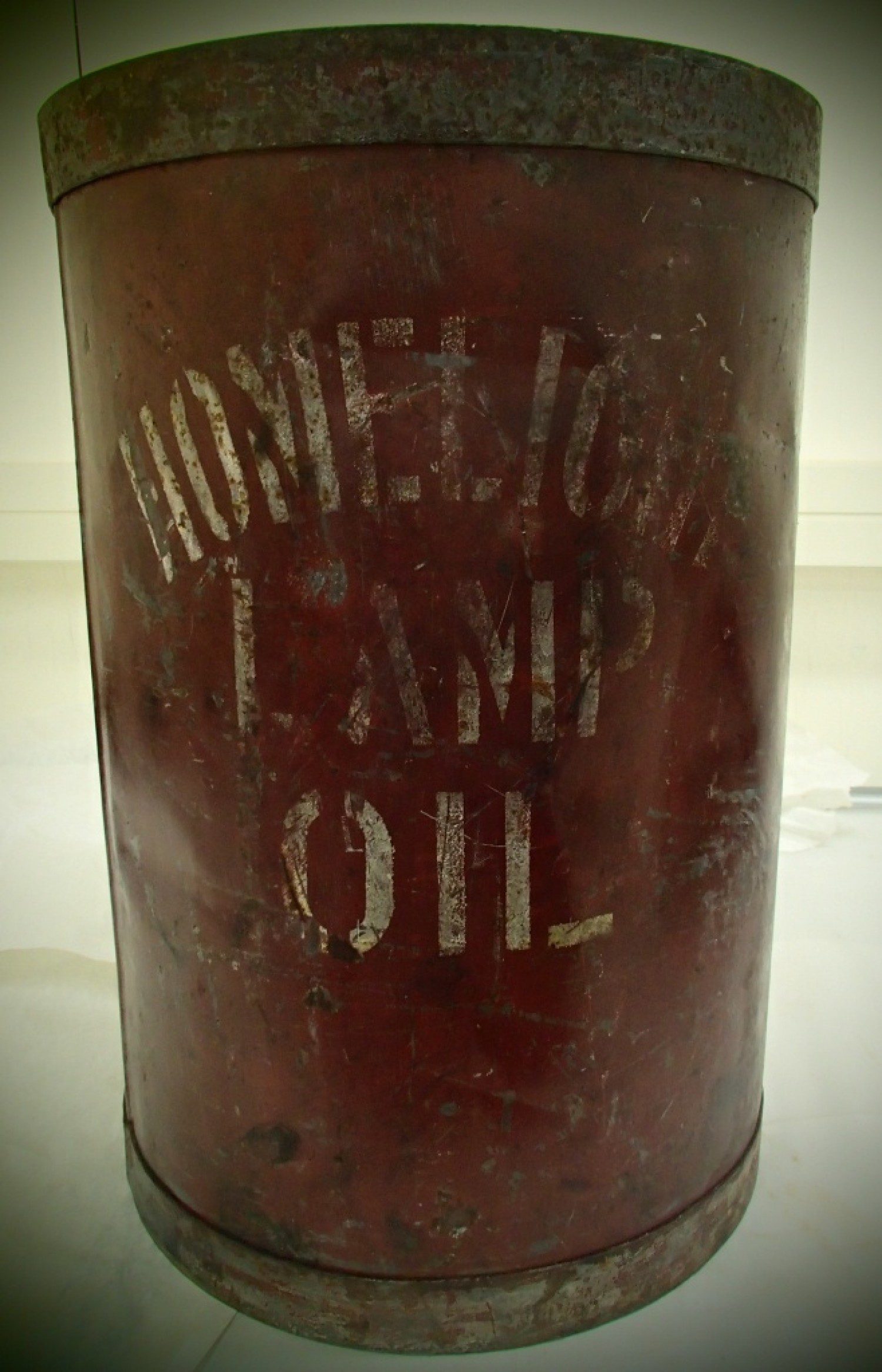
Back to reality. Lucky for me, my reality is most of the above combined with corrosion removal during the day. And I’ve just completed conserving a fabulous large Homelight Lamp Oil fuel can from Discovery Hut which was a provision of the British Antarctic Expedition.

Homelight lamp oil canAntarctic Heritage Trust

Homelight lamp oil can

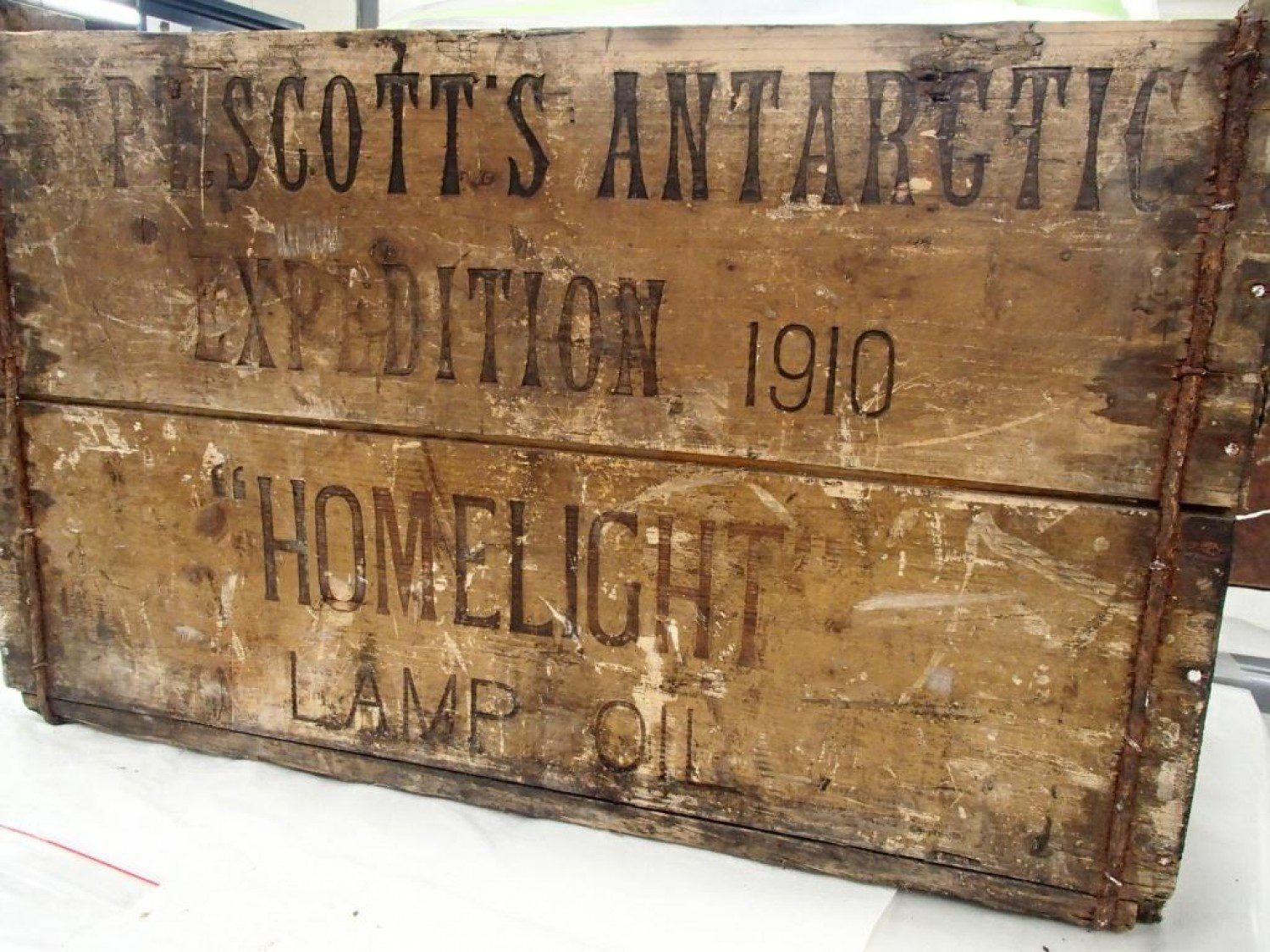
The same brand of oil was also sent down in this beautiful wooden box.

Wooden boxAntarctic Heritage Trust

Wooden box

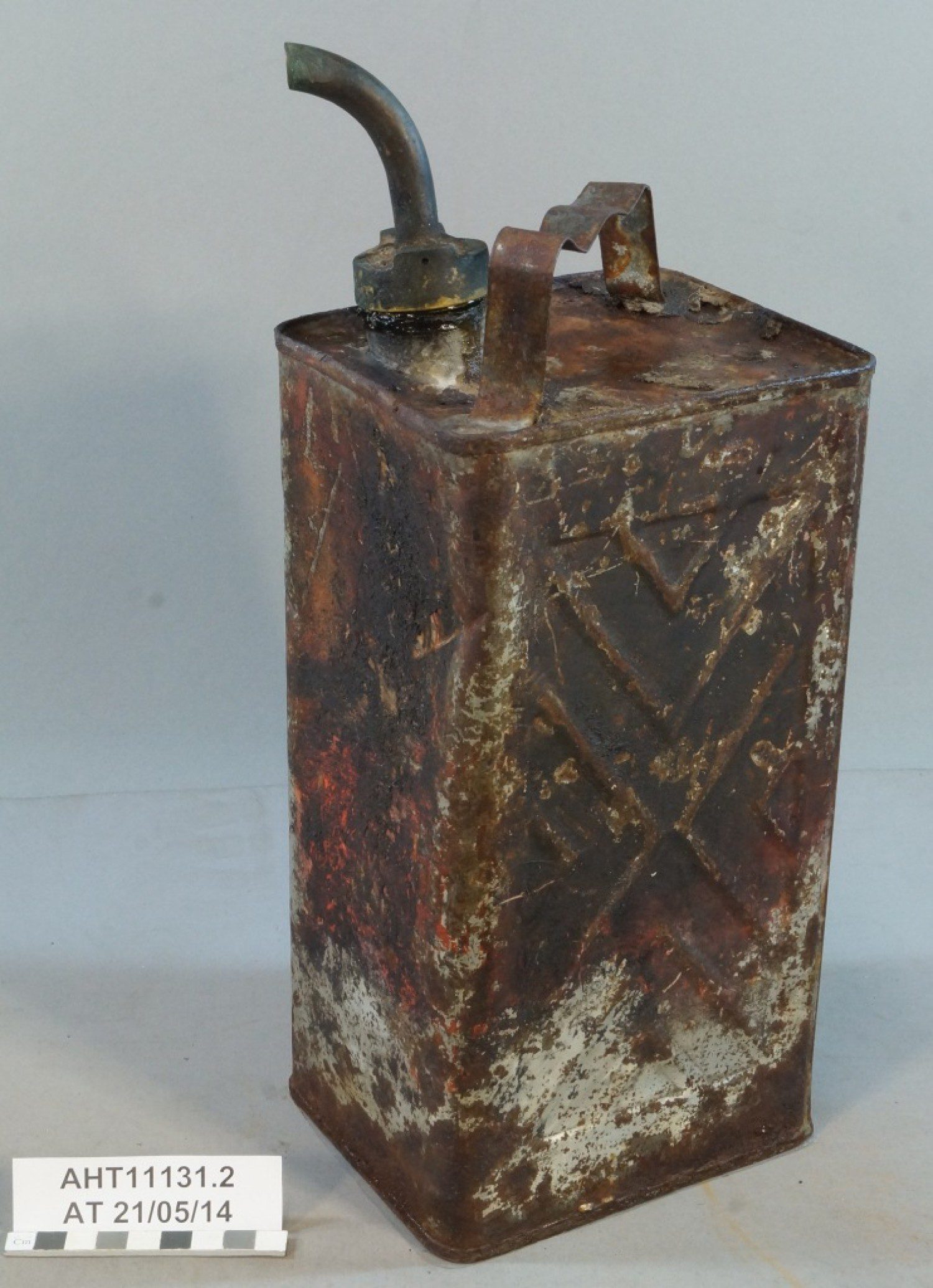
I’ve also recently worked on small oil cans containing oil in remarkably good condition. There were many types of oils and fuels, including calcium carbide for acetylene lighting, brought down on the historic expeditions to create heat and light for the long winters, with seal blubber as the final resort.

Small oil canAntarctic Heritage Trust

Small oil can

At Scott Base today we have all the heat and lighting required to live an exceptionally comfortable winter existence provided mostly by diesel fuel generation with an impressive 22% of delivery by wind power. Plus a toasty gas powered ‘log’ fire to read Scott’s Journal in front of. 

https://nzaht.org/wp-content/uploads/2019/01/wooden-box56ccea489f3cb9.83313628-1500x.jpg 1125 1500 Comms https://nzaht.org/wp-content/uploads/2019/03/logo-dark.png Comms2014-06-11 01:36:492019-05-01 06:59:47Let There Be Light … and Heat!
Page 9 of 10«‹78910›

Latest Inspiring Explorers Updates

  • Connections Create Life-changing Experience in South GeorgiaDecember 14, 2023 - 1:43 pm
  • South Georgia Expedition OutreachMay 30, 2024 - 9:48 am
  • A group of young people standing around a memorial statue of an explorer.Icy Fun and Learning at SummitDecember 14, 2023 - 1:43 pm
  • ‘Polheim’ World Premiere AnnouncedJanuary 30, 2024 - 11:21 am
  • Encouraging the Next Generation of Antarctic ConservatorsDecember 14, 2023 - 1:43 pm

Facebook

Stay in touch
  • Facebook
  • Twitter
  • Youtube
  • Vimeo
  • Instagram
  • LinkedIn
About AHT Our People Latest News Contact Us Image Archive Shop
QUICK LINKS
About AHT Our People Latest News Contact Us Shop Conserve Share Encourage Sustain
Conserve Share Encourage Sustain

Make a donation

Donate

Become a member

Join

Antarctic Heritage Trust

Antarctic Heritage Trust
7 Ron Guthrey Road, Christchurch 8053, New Zealand
Private Bag 4745, Christchurch 8140, New Zealand

Antarctic Heritage Trust

Antarctic Heritage Trust
7 Ron Guthrey Road, Christchurch 8053, New Zealand
Private Bag 4745, Christchurch 8140, New Zealand

© Copyright 2024, Antarctic Heritage Trust – Registered Charity: CC24071
Terms and Conditions – Privacy Policy

© Copyright 2024, Antarctic Heritage Trust
Registered Charity: CC24071
Terms and Conditions – Privacy Policy

Scroll to top