Expedition Blog – Margot Martin-Babin, Antarctic Peninsula 2026
On Choosing Discomfort
Sailing a Tall Ship to the Antarctic Peninsula
Part 1: A Series of Escalating Choices
There is something incredibly motivating about living through an experience which reminds you that life is finite, and that a long life is not always guaranteed. After that, the fear of doing nothing with your life starts to outweigh the fear of doing something crazy. That describes my twenties, and it offers insight into how a young woman from a small town in the South Island (Blenheim represent!) ends up doing something genuinely mad like sailing to Antarctica on a 100‑year‑old tall ship and navigating some of the most dangerous seas on the planet.
For those who do not know me, I’m Margot: a 29‑year‑old French‑Kiwi living in Auckland, working in public health, happiest outdoors, and always saying yes to new experiences.
When the opportunity to apply for this expedition came up, it wasn’t about Antarctica being a lifelong dream. It was about choosing to live a full life and seeking out experiences that leave a mark. It was also about building my resilience and leadership capability, as I work towards a career in public health. For me that means choosing to do things others might deem too hard, or too uncomfortable.
I had tried once before, in 2023, applying for the Inspiring Explorers Expedition™ to South Georgia Island. I missed out, but sat quietly hopeful on the reserve list (to no avail). Still, it showed me that going to Antarctica was something I wanted badly enough to try again.
This clarity did not make the decision to apply easy. The words “tall ship” in the expedition advert absolutely terrified me. I am not a sea person, nor a boat person, and the idea of weeks on the Southern Ocean filled me with dread. But the Inspiring Explorers™ programme has an age cut‑off of 30, and this expedition felt like my last chance.
So, I applied. Consequences be damned.
When Inspiring Explorers™ Programme Manager Mike Barber, called to offer me a place, it was an out of body experience. I remember hearing myself say yes immediately, even though the idea of sailing to Antarctica on a tall ship was objectively terrifying. Well, for me anyway.
As it turned out, the universe decided to test my resolve earlier than planned.
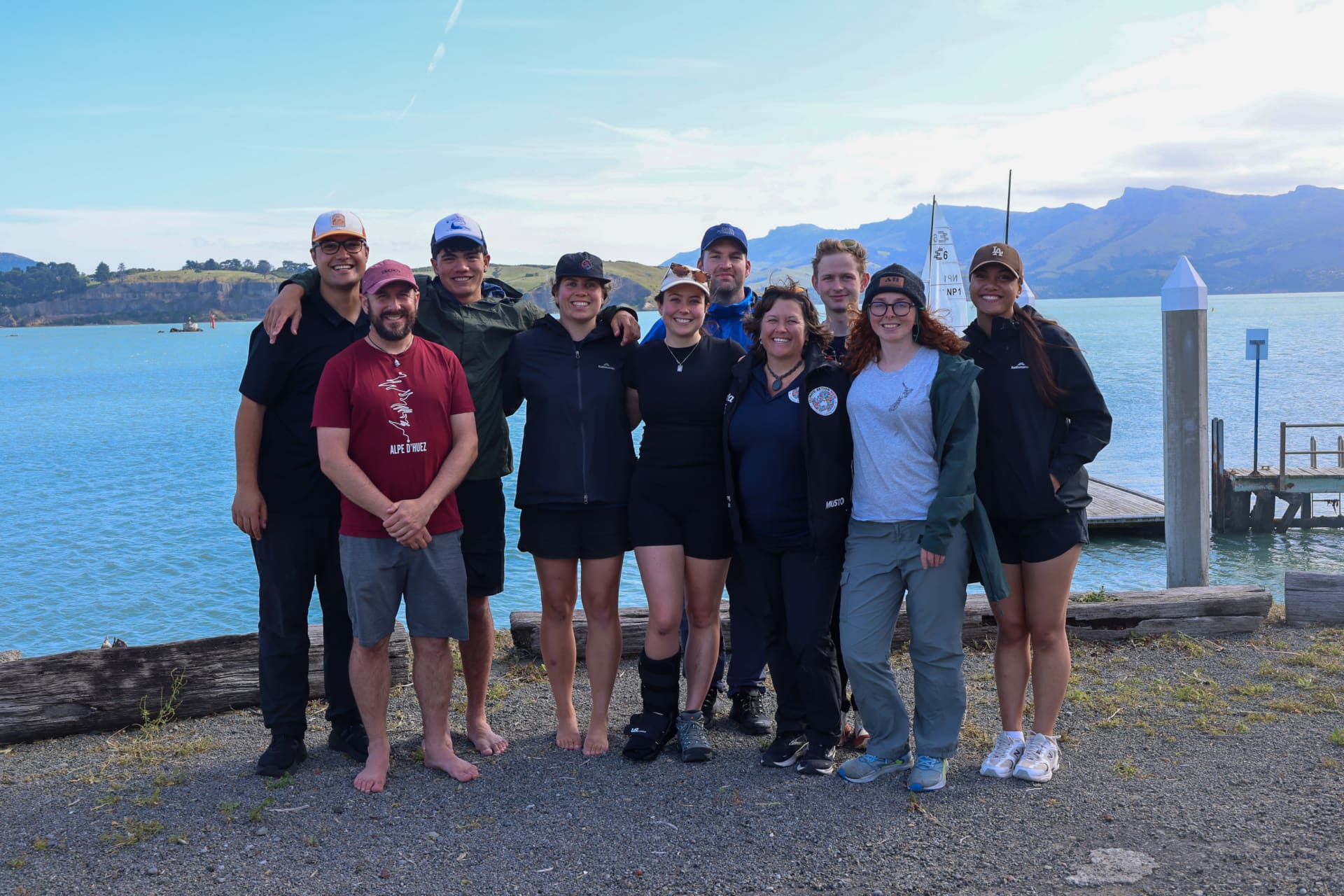
A week out from our November team‑building weekend in Lyttelton (NZ), I fractured my foot. Along with it went a significant chunk of my confidence in my physical ability. Being injured and forcibly put ‘on the bench’ was, unsurprisingly, not part of the Antarctica training plan. It’s undeniably harder to bond with a team when you’re stuck on the sidelines in a moonboot, watching everyone else throw themselves into activities you can’t fully participate in. It amplified my anxiety about the journey ahead.
Part 2: The Crossing
If choosing to apply for this expedition was about choosing discomfort, the Drake Passage was about living with that choice. As a lover of memes, this one immediately comes to mind: “well, well, well… if it isn’t the consequences of my own actions.”
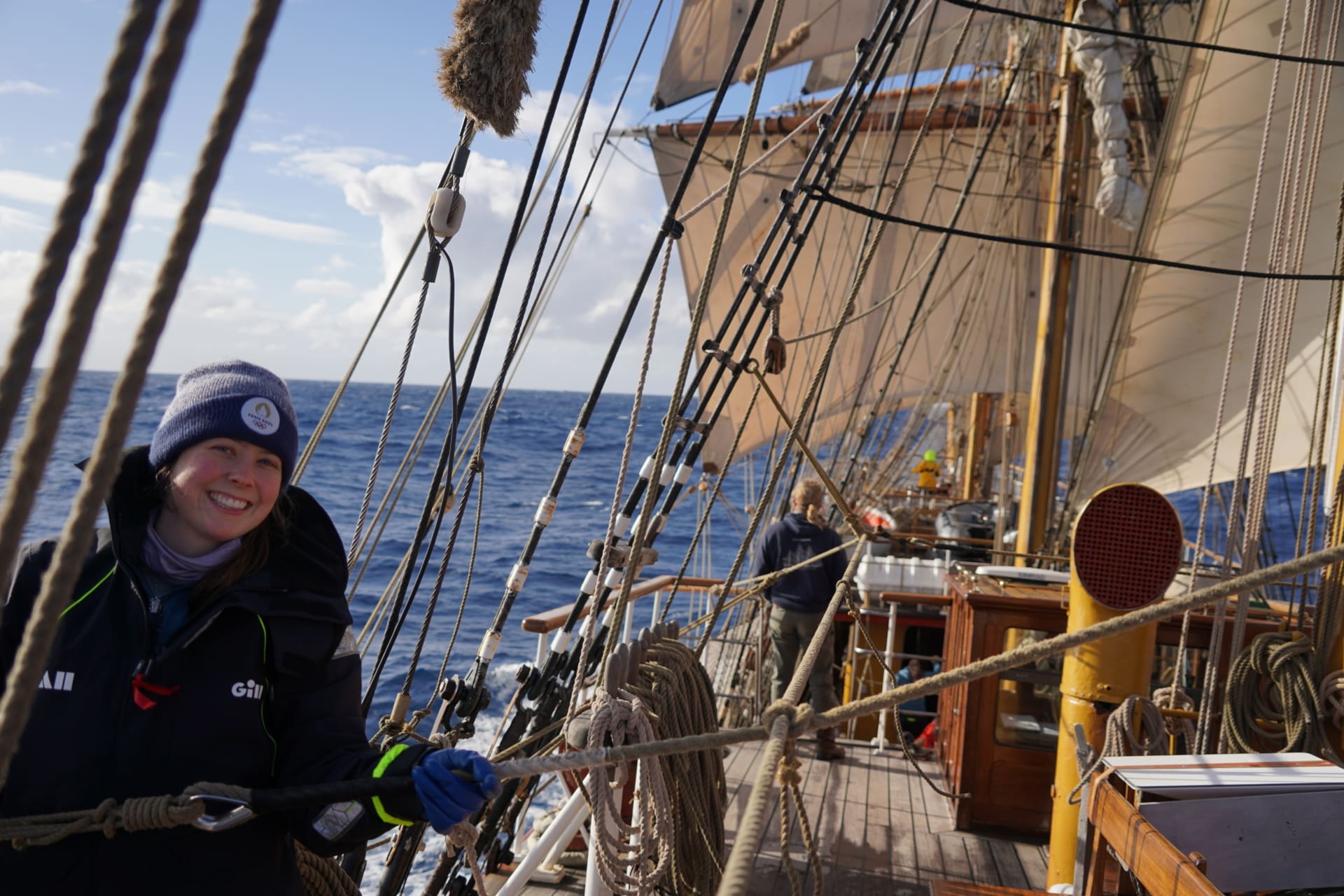
Our first day on the Beagle Channel lulled me into a false sense of security. The water was calm, the ship steady, and I successfully climbed the rigging. After months of worrying, especially after the fractured foot debacle, realising that my body could still do this, that I was capable after all, was exhilarating. For the first time since the injury, I felt strong. I felt unstoppable.
That was nice while it lasted.
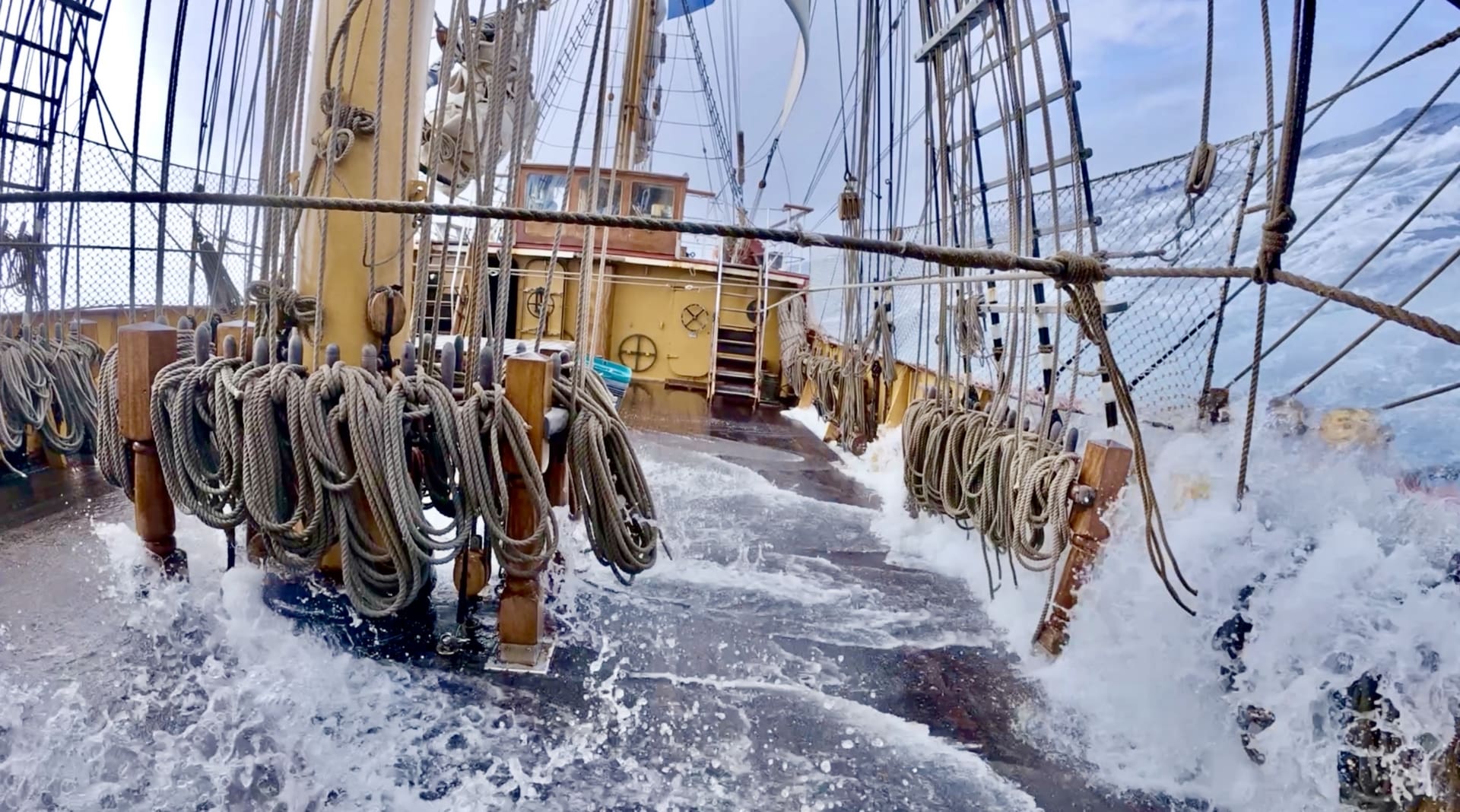
The infamous ‘Drake Shake’ on our way to the Antarctic Peninsula pushed me to my physical and mental limits. Days blurred together in a fog of nausea, thirst, and exhaustion. Even simple tasks, like brushing my teeth, felt impossible. Carrying my yellow emotional support bucket quickly became routine.
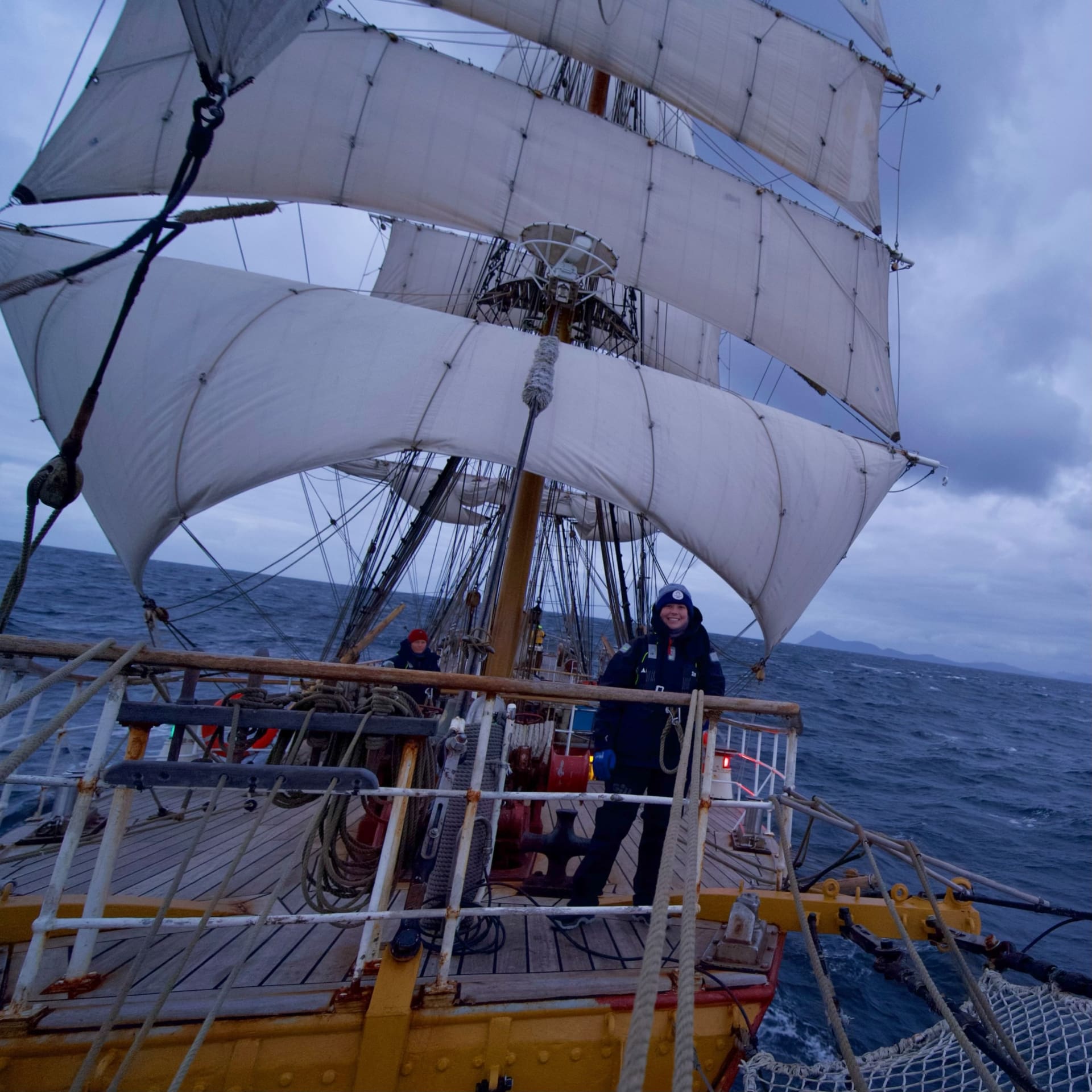
Eight‑metre swells rose around us, towering over the ship before crashing back down onto the deck. The EUROPA pitched violently from side to side, sometimes tilting close to what felt like ninety degrees. Standing upright was a challenge. Moving through the ship required strategy. People were flung across rooms, and anything left unattended on a table was immediately sent flying. Cups, cameras, buckets – nothing was safe.
Life aboard the EUROPA did not pause for seasickness. We ran sailing watch schedules of four hours on and eight hours off, for five days straight: helming, keeping lookout, and hauling countless ropes – all the way to the South Shetland Islands. Despite everything, I loved my watch (go Blue!). The people I stood alongside were kind, patient, and encouraging.
Teamwork was not optional on board. I had to rely on others, something which does not come naturally to this fiercely independent girl. But shared hardship forges bonds quickly. It makes everything feel more bearable, and you realise how much more you can achieve together. The fear I had carried about not bonding with the team disappeared.
Sailing across the Drake was also a huge test of mental resilience. I consider myself a resilient person, but this pushed me to my limits. The thing is, once you’re on the ship, there’s no getting off. You have to endure. I learned to narrow my focus to the next watch, the next hour, the next task. Thinking too far ahead felt dangerous. I knew if I did, I would break.
Nothing compares to the elation of seeing the towering icy cliffs of Smith Island emerge on the horizon after that first crossing of the Drake. Tangible proof we had made it through.
We were here.
Part 3: At the Edge of the World
When we finally reached land, the relief was visceral. I could hardly believe what I had done – survived sailing across the Drake Passage. Putting my foot down on solid ground after days at sea felt like a monumental victory.
The South Shetland Islands gave us our first taste of Antarctica: penguins, wind, ice, and rapidly changing conditions – a place that is beautiful, harsh, and uncontrollable. But it was only once we reached the Antarctic Peninsula that the significance of what we were experiencing truly hit me.
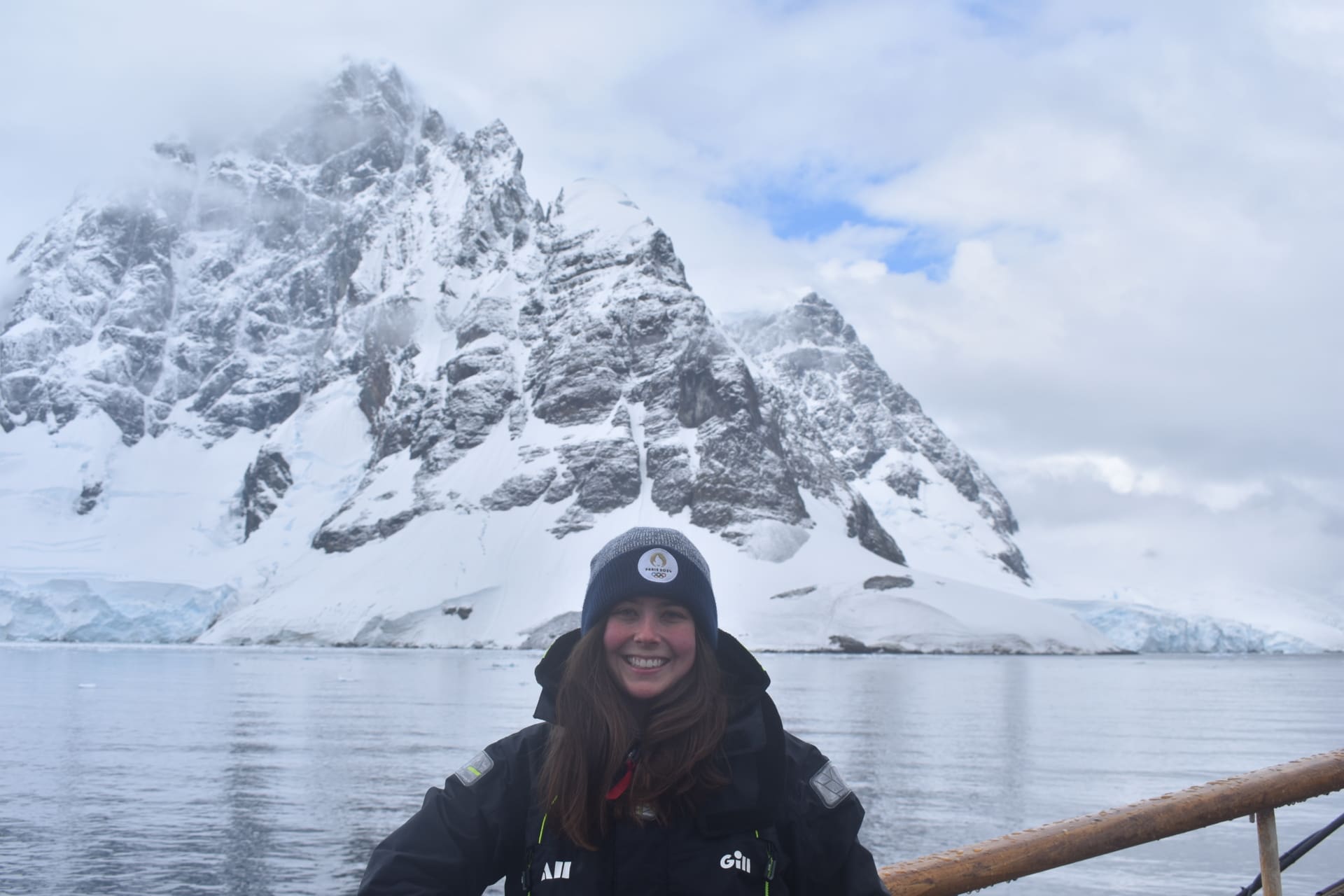
What struck me most was the sheer size and scale of the continent. Standing at the foot of glaciers, or looking back at the Bark EUROPA dwarfed by towering walls of ice, I felt small and inconsequential, but also intensely alive. There was something incredibly grounding about that.
The moment which has stayed with me most came not on land, but on the water, in the Graham Passage. Snow fell and settled on the deck of the EUROPA as four humpback whales fed right beside the ship. It felt magical, as if the whales were dancing through the ocean and the snow. They treated us to spectacular flipper raises and perfect flukes. Mike Barber was taken out by a perfectly aimed snowball, and someone built an adorable little snowman. After the intensity of the crossing, it felt good to laugh.
Beneath that joy, I was overwhelmed by the privilege of the moment, and immensely thankful for the generosity of the strangers who had made it possible for me to be there.
That feeling followed me throughout our time on the Peninsula. Whether we were navigating narrow, ice‑filled channels, watching seals lounge on gravity‑defying icebergs, or hiking to penguin rookeries perched improbably high above the sea, the environment constantly reminded me that we, as humans, were visitors here, and that I was so lucky to be one of them.
There was also the uncomfortable realisation that human civilisation is already impacting this supposedly untouched place. In the ship’s library, I read an account of a previous voyage to Deception Island describing snow‑covered landscapes and abundant wildlife where we now saw bare ground. At Jougla Point, rain fell where snow should have, soaking Gentoo chicks that had not yet developed waterproof feathers. Watching their parents desperately try to keep them alive while we stood by, committed to not interfering, was one of the hardest moments of the trip; especially for someone like me, who works in healthcare, where the foundation of my work is preserving life. It was a confronting, real‑world glimpse, of climate change.
And yet, going to Antarctica has only fuelled my curiosity. Hindsight is powerful (and heavily rose‑tinted) and the horrors of the Drake Passage already feel like a distant memory.
Sitting here now, writing this, I feel a strong pull to return and explore more of the continent. When you look at a map of Antarctica, you realise how little we actually saw.
I’ve found myself engaging with the Trust’s outreach projects from previous cohorts, like the short films Polheim, and Across the Atlantic. Antarctica is an addictive drug.
Part 4: Confessions of a Land Lover
As the expedition came to an end, I was surprised by how conflicted I felt. In some ways, it felt like we had only just arrived. Seven days in Antarctica is not long at all. In other ways, I was ready to return home, reconnect with the people I love, and to try to articulate an experience I knew would be difficult to translate. No photograph could fully capture the magic, the scale, or the silence of the place.
The return trip across the Drake was far smoother, and to my surprise, I enjoyed the sailing and being at one with the sea and its inhabitants, both marine and avian. I also got to helm the EUROPA as she rounded Cape Horn, a moment that was both terrifying and exhilarating. Still, at the end, I was very happy to be firmly back on land.
There are aspects of the expedition I still think about often. The biosecurity measures we followed to keep ourselves safe and prevent the spread of avian influenza (bird flu) from one place to another, reminded me of my experiences working in the health system during the COVID‑19 pandemic. It made me consider whether human and animal infectious disease crises can be approached in similar ways, and how much we might learn from shared experience to respond more effectively in the future.
I also learned a great deal about my own leadership capability. As one of the older members of the group, I naturally fell into a mentoring role, and was surprised by how comfortable I felt in it. I quickly realised that I am capable of more than I often give myself credit for.
I was also impressed by our team of Inspiring Explorers™. One of our core strengths was our ability to connect with the other passengers (or voyage crew as we were referred to) on board. People bonded quickly with their watches and were committed to doing their part, both to sail the EUROPA successfully and to build a positive culture on board. I wouldn’t have wanted to sail to Antarctica with anyone else.
To Antarctic Heritage Trust, the Inspiring Explorers™ programme, and its sponsors, I am forever grateful for the opportunity to be part of this expedition. To the crew of the Bark EUROPA, our mentors, the other voyage crew, and everyone else who made this journey possible, thank you. You changed this young woman’s life more than you will ever know.
This trip was the hardest thing I have ever done – and also the best. I have learned so much about Antarctica, about sailing, and about myself. It was uncomfortable a lot of the time, but unbelievably inspiring, almost all of the time. It is a powerful reminder to all of us about why saying yes to hard things matters.
Because growth requires discomfort.
Thank you to our generous Inspiring Explorers™ Fund donors, expedition partner Spirit of Adventure Trust, sponsor Burnsco, and supporter Bark Europa.